
The decision usually arrives as a comparison between two instruments with nothing in common except the black and white keys. One has hammers and strings and needs tuning; the other plugs into the wall, lights up under your fingers, and reports what you played back to an app. Comparing smart piano vs traditional piano by specification gets you nowhere, because they are not the same category of object.
What actually decides it is how the instrument fits your room, your evenings and your budget over three years. Below are the differences that show up in ordinary use, the ones that are marketing rather than substance, and the situations where each is clearly the wrong purchase. The smart pianos referenced are TheONE models, with prices checked on 28 September 2026.
What each instrument actually is
A traditional piano makes sound mechanically. Pressing a key lifts a hammer onto a string, and the sound comes from the string, amplified by the soundboard. Nothing about that changes if the power fails, and the instrument is tuned by a technician who physically adjusts the strings.
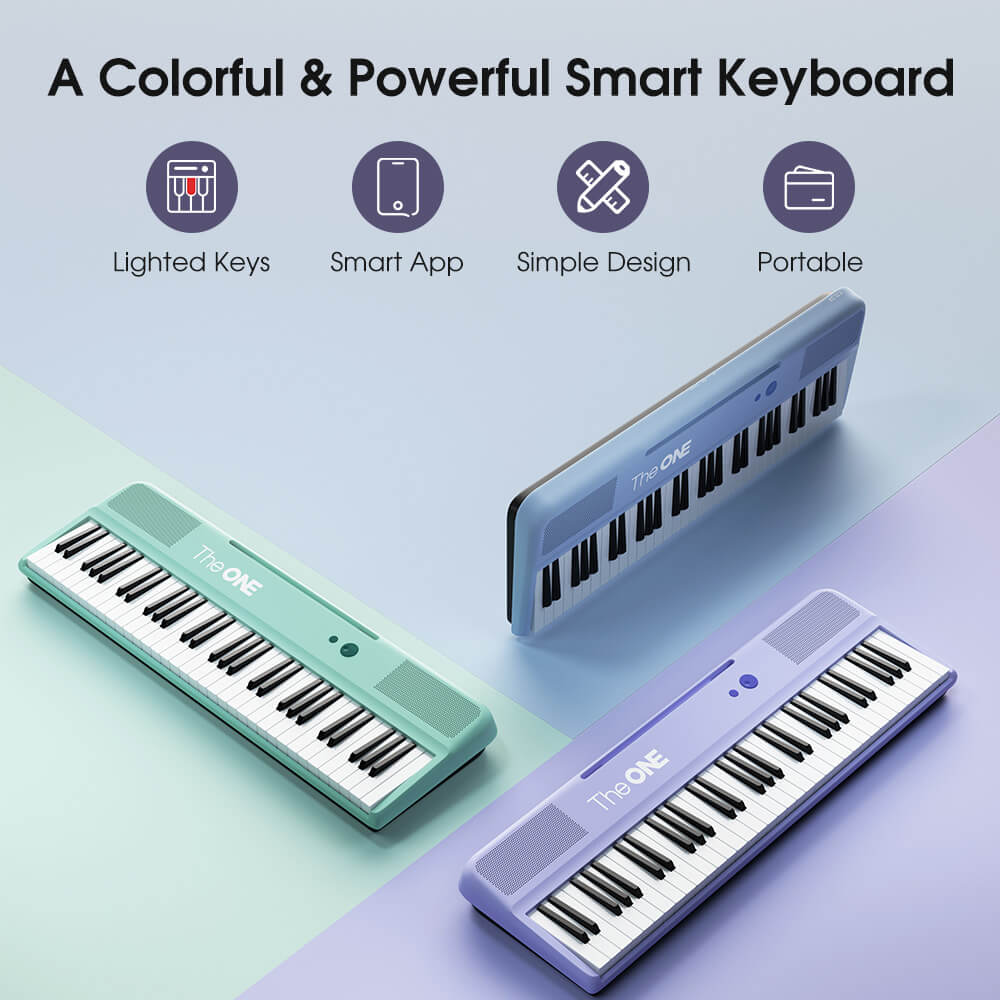
A digital piano, smart or otherwise, plays recordings of a grand piano. The key sends a signal and the instrument plays back a sample, through speakers or headphones. A smart piano adds a layer on top: the keys light to show the next note, the instrument reports what you played, and a companion app marks mistakes and adjusts tempo, pairing over Bluetooth on iOS 15.6 and Android 7.0 and above. The TheONE COLOR is the clearest entry point at $325, with 61 lighted keys and 64-note polyphony.
That difference is worth stating plainly, because the words are used loosely. "Electric" and "digital" describe the sound source. "Smart" describes what the instrument can teach you. A digital piano without an app is still a digital piano, and this is the distinction that decides whether a beginner practises alone or with something correcting them.
Can you learn on a smart piano?
Yes, and the app replaces some of what a teacher does.
Notes, timing and coordination all transfer to any other keyboard or acoustic piano. What a smart piano cannot judge is phrasing, so add recordings or occasional lessons once the basics are in place.
The reason this question gets asked is a reasonable worry: that learning with lights produces someone who can only play with lights. The concern is real but limited. Guided modes teach note location and rhythm, which is exactly what the first year is about, and players who continue usually move into reading notation as their hands stop needing the hints. Graded material from a body such as the Royal Conservatory of Music is a useful way to test yourself without the app switched on.
What a traditional piano gives you that a smart piano does not is immediate tactile feedback on technique. A hammer action tells you through your hand when you play unevenly, because the resistance changes. A good digital action imitates this closely, but imitation is what it is. If your goal is classical repertoire performed on an acoustic instrument, some time on one matters at some point.
Which instrument fits your room and your evenings
This is where the two diverge completely, and it usually decides the purchase before sound is discussed. A traditional piano has no volume control. Practice happens when the household permits it, and in a flat that means negotiations. A digital piano plays through headphones, so the loudest thing in the room becomes the sound of the keys themselves. Keep that headphone level low enough to hear a conversation, which is the practical form of the guidance in the World Health Organization's listening-safety programme and the NIDCD's material on noise-induced hearing loss.
Space is the second constraint. An upright acoustic instrument is a piece of furniture with a footprint you cannot move alone, and it needs a wall that is not against a radiator or an outside wall, because humidity changes affect tuning. A digital console piano occupies a smaller footprint and is immune to humidity. A portable model folds the problem away entirely: the COLOR is 7.7 lb and runs on batteries, so it can move rooms, travel, or be stored when the room is needed for something else.
Then there is upkeep. A traditional piano needs tuning on a schedule, and the cost never stops. A digital instrument needs none. The trade is that a digital instrument has a service life in its electronics, while a well-kept acoustic piano will outlive its first owner. The OSHA explanation of noise exposure is unrelated to tuning, but it makes the wider point well: anything that produces sound on a daily basis comes with a maintenance question attached, and only one of these two instruments answers it by itself.
Smart piano vs traditional piano compared
The table below sets a 61-key smart keyboard and an 88-key weighted smart piano against what a traditional acoustic instrument asks of its owner. Prices are in US dollars, checked on TheONE's product pages on 28 September 2026.
| Traditional acoustic | TheONE COLOR | TheONE PLAY | |
|---|---|---|---|
| Sound source | Hammers and strings | Recorded samples through speakers | Recorded samples through four speakers |
| Keys | 88, weighted | 61 full-size, touch response | 88, graded hammer action |
| Tuning | Needs regular tuning | Never | Never |
| Volume control | None | Yes, plus headphones | Yes, plus headphones |
| Weight | Moves with a team | 7.7 lb (about 3.5 kg) | 107 lb (about 48.5 kg) |
| Teaching features | None | Lighted keys and app | Lighted keys and app |
| Price (US$) | Depends on the instrument and its condition | $325 | $1,599 |
Notice what the comparison does not contain: a column for sound quality. At beginner level, the more useful question is which instrument you will actually sit down at on a Tuesday evening. The acoustic wins on reference tone and long-term value; the smart piano wins on frequency of practice, which is the variable that determines whether there is any progress to compare.

Who each one suits
A traditional piano suits a household where the instrument has a permanent home, nobody needs to practise after nine at night, and the sound of an acoustic instrument is the point of owning one. It also suits a family where a teacher has specified an acoustic instrument for exam preparation.
A smart piano suits almost everyone else: an adult learning around a job, a child in a shared house, anyone in a flat, anyone who moves, and anyone who would rather have feedback than a silent keyboard. The 88-key weighted models such as the TOP1X at $1,999 and the TOP2 Pro at $2,399 carry the weighted feel that classical learners want, while the 61-key COLOR at $325 covers the first year for a fraction of the cost.
Neither is a compromise of the other. They solve different problems, and the most common mistake is buying the instrument that sounds better in a showroom rather than the one that is playable at the time you are free.
Common misconceptions
The first is that a digital piano is a toy. A graded hammer action instrument with 88 weighted keys is a real instrument, and the difference between it and a light keyboard is far larger than the difference between it and an entry-level acoustic. The second is that an acoustic piano needs no electricity or maintenance; it needs no power, but it does need tuning, and a neglected acoustic instrument is worse to practise on than any digital one. The third is that learning with lights prevents you from learning to read music, which is only true if you never turn the lights off.
Wait before buying an acoustic piano if you have not yet checked how the room behaves through the seasons. Humidity changes shift tuning, which is why the same instrument can sound different in July and January. A digital instrument removes that variable entirely while you work out whether the habit is real.
FAQ
Can you learn piano on a smart piano?
Yes. A smart piano teaches the same notes and timing as any other keyboard, and the app replaces part of what a teacher would correct in the first year. What it cannot do is hear your phrasing, so pair it with recordings of yourself or occasional lessons once the basics are in place.
Does a traditional piano need more upkeep?
Yes, and that is a permanent cost rather than a one-off. An acoustic piano needs regular tuning and reacts to humidity, while a digital instrument never needs tuning at all. Budget for the upkeep before you buy, not after, because an out-of-tune piano is the fastest way to stop a beginner from practising.
Which holds its value better?
A well-kept acoustic piano usually holds more value, because it is furniture and an instrument with a long service life. Digital instruments date as electronics do. Neither should be bought as an investment; the question is which one you will still be playing in three years.
Can you play a smart piano quietly?
Yes, through headphones, and that single feature changes how often beginners practise. An acoustic piano has no volume control, so practice happens when the household allows it. If late-evening practice is when your free time exists, that difference decides the purchase.
Next step
Answer one question honestly: when in the week will you actually play? If the answer is an evening or an early morning, the volume control decides it. If the answer is a Sunday afternoon and the instrument has a permanent home, an acoustic piano is a genuinely better long-term possession — and a weighted digital piano is the sensible way to find out whether that home is where the habit will live.
Shipping and returns in short. TheONE ships free within the 48 contiguous United States, with orders usually processed in 1–3 business days and delivery estimated at 3–7 business days after dispatch. International delivery is estimated at 5–15 business days, with shipping and applicable taxes included in the price shown at checkout. Returns within the United States can be requested within 30 calendar days of receipt and require approval.
Compare the 61-key portable and the 88-key weighted pianos, including the models built as home furniture.
If the reason you are weighing an acoustic instrument is the range, the guide to 61 keys vs 88 keys covers what the extra keys change. If your constraint is a small room rather than the piano type, digital pianos for small apartments deals with that directly.