
The room is four metres by three, the desk already fills one wall, and you are trying to work out whether a piano can live in the space that is left. Choosing a digital piano for a small apartment is not a compromise on quality; it is a question about footprint and timing that most buying advice skips entirely.
Two constraints decide almost everything: how much floor the instrument takes once it is set up, and when you are actually free to play. Both have specific answers, and neither requires an expensive instrument. This guide covers the sizes, the noise path, and the accessories that make a small room work.
The models and accessories referenced are TheONE products, with specifications and prices taken from TheONE's product pages on 28 September 2026. This is not an independent test.
What makes a piano workable in a small flat
Two things, and they are both about the room rather than the instrument. The piano has to stay set up, because anything that has to be assembled is played less often. And it has to be quiet on demand, because in a flat the hours when you are free are often the hours when other people are asleep.
Both point to the same design. A digital piano produces sound through speakers or headphones, so the second constraint is solved by plugging in a pair of headphones. The first is solved by footprint: a portable keyboard on a stand occupies roughly the floor area of a chair, while a console piano with a cabinet behaves like a piece of furniture that claims a wall permanently.
That is the real decision, and it is worth making before you compare specifications. An 88-key weighted piano with a beautiful cabinet is the better instrument in a room that can host it, and the wrong purchase in a room that cannot. Footprint is not a compromise; it is the constraint that should decide the shortlist.
How much space does a digital piano need?
A portable keyboard needs a corner; a console needs a wall.
The TheONE PLAY measures 54 by 18 by 33 inches at 107 lb, so it claims a permanent spot. A 61-key portable model on a stand takes a fraction of that and can be folded away when the room is needed.
Measure in two directions rather than one. Width is obvious, but depth matters more in a narrow room, because the bench needs to pull out behind the keyboard and you need room to sit without your back against the sofa. Roughly a metre of clear depth behind the keys is comfortable; less than that and you end up playing at an angle, which is how posture problems start.
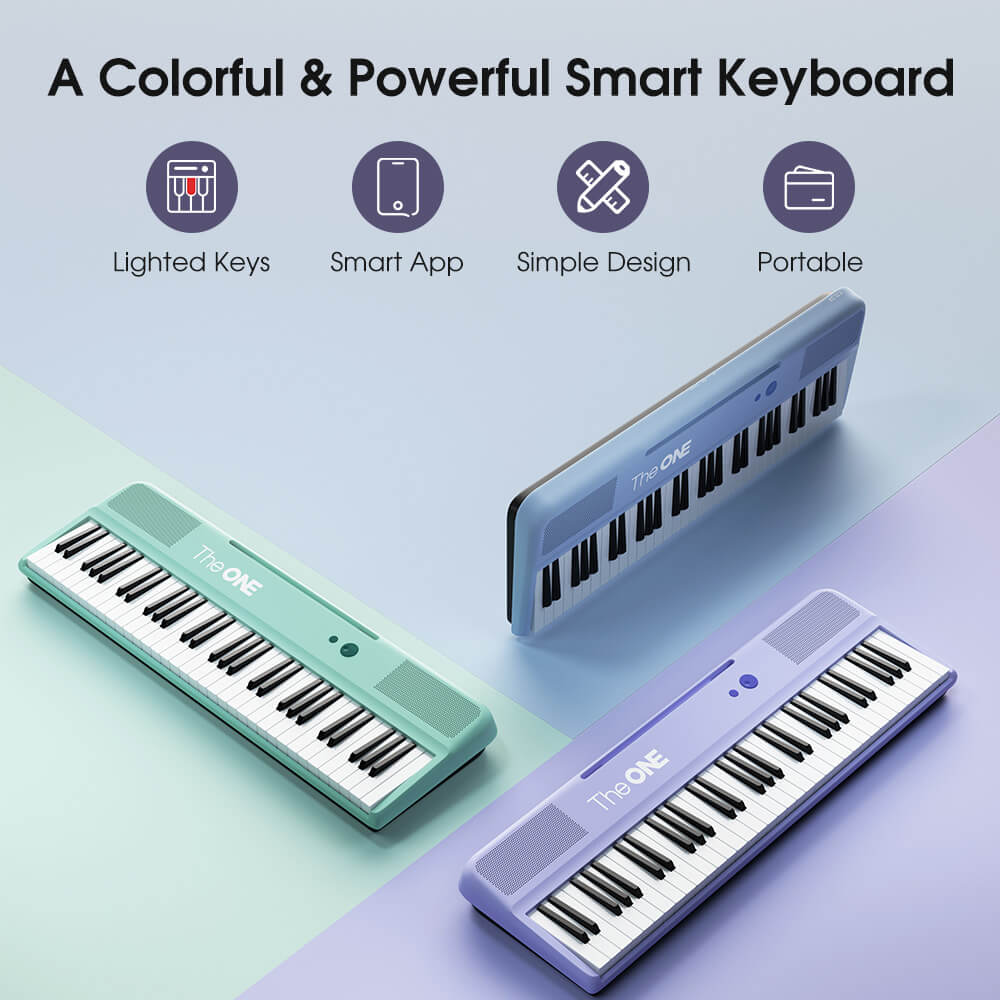
The alternative is the portable route. The COLOR is 7.7 lb with 61 full-size keys and can run on AA batteries, so it can be played on a bed, at a desk or in another room, then put away. The compromise is the key action: it uses touch response rather than a graded hammer action, so it teaches notes and rhythm but not the finger strength a weighted key develops.
Will the neighbours hear you play?
Through headphones, no. Through speakers, rarely.
The audio goes into your ears rather than the room, and what is left is the mechanical sound of keys and pedals. That is quieter than a normal conversation and rarely reaches another flat.
What does travel is impact rather than volume, and that is a structural question. Vibration passes into the building through whatever the instrument touches, which is why a piano on a concrete floor behaves differently from the same instrument on a suspended timber floor. Sitting the stand on a rug helps at the margin, and placing the piano against an internal wall rather than over a downstairs bedroom handles most of the rest. It is the same principle the Occupational Safety and Health Administration describes for noise exposure: what matters is the path between the source and the listener, not only the level at the source.
If you also practise with headphones, keep the level sensible — the risk in audio comes from long exposure rather than single peaks, which is why the NIDCD's guidance on noise-induced hearing loss and the World Health Organization's listening-safety programme both focus on duration. Practice daily and it becomes a habit worth getting right from the start.
Where to put it in a small room
Three placements work better than others, and none of them costs anything. An internal wall rather than an external one avoids both draughts and the humidity swings that affect tuning on acoustic instruments. A spot that is not directly above a neighbour's bedroom removes the impact question entirely. And somewhere you walk past rather than have to reach for is the placement that gets played.
The last point is worth more than it sounds. A piano in a spare room is a piano you visit; a piano in the corner of the living room is one you sit at while the kettle boils. If the room is small enough that this is a real choice, choose the more prominent position and accept the slight crowding, because frequency of practice is the variable that decides whether any of this works.
| TheONE COLOR | TheONE PLAY | |
|---|---|---|
| Keys and action | 61 keys, touch response | 88 keys, graded hammer action |
| Footprint | Portable on a stand, stores away | 54 by 18 by 33 in, permanent |
| Weight | 7.7 lb (about 3.5 kg) | 107 lb (about 48.5 kg) |
| Power | AA batteries or DC 5V cord | Mains power |
| App time included | Three months | Six months |
| Price from (US$) | $325 | $1,599 |
Read it as a question about your lease rather than your ambitions. If you expect to move within two years, or the room does double duty, the portable route is simply correct, and it stays correct even if the budget is larger. If the flat has a wall that will still have a piano against it in five years, buy the weighted action now.
What else a small setup needs
A stand at the right height and a pair of headphones, in that order. The TheONE double-X stand costs $119 and fits both the 61-key and the 88-key models, with an adjustable height that lets two people of different sizes share it. The single-X stand is also $119 but fits the 61-key COLOR only, so check the model before ordering. Headphones are $119 and matter more in a flat than in a house, because they are what make an evening practice session possible.
A bench is the third item and the one people skip. The TheONE piano bench is $149 at 22 by 14 by 19 inches with a PU seat and wooden legs, and it puts you at a height where your forearms sit roughly level with the keys. Playing from a sofa or a low stool is uncomfortable within ten minutes, and discomfort is what turns a daily habit into a weekly one. On the connected side, the piano pairs over Bluetooth on iOS 15.6 and Android 7.0 and above, with a cabled option using USB host for Android 7.0 and above, so a flat with no spare desk space does not need one.

FAQ
How much space does a digital piano need?
A 61-key portable keyboard needs about the footprint of a large laptop once it is on a stand, while an 88-key console piano needs a permanent wall. The TheONE PLAY measures 54 by 18 by 33 inches and weighs 107 lb, so measure the wall before you order.
Will the neighbours hear a digital piano?
Through headphones, no. The sound leaves through the speakers or your headphones, so playing at eleven at night is entirely possible. What still travels is the mechanical noise of keys and pedals, which is quieter than a conversation and rarely reaches another flat.
Can you practise at night in a flat?
Yes, with headphones at any hour. A digital piano makes almost no airborne sound on its own, so if noise is your constraint the choice is settled by headphones rather than by the instrument. Keep the level low enough that you can hear someone speaking to you.
Next step
Measure the depth, not just the width, and decide whether the piano will have a permanent home. A portable 61-key model plus the double-X stand comes to under $450 and fits almost anywhere. If the answer is a permanent wall, skip the compromise and buy the weighted action once.
Shipping and returns in short. TheONE ships free within the 48 contiguous United States, with orders usually processed in 1–3 business days and delivery estimated at 3–7 business days after dispatch. International delivery is estimated at 5–15 business days, with shipping and applicable taxes included in the price shown at checkout. Returns within the United States can be requested within 30 calendar days of receipt and require approval.
See the portable pianos that fit a small room, along with the stands and benches sized for them.
If the constraint is noise rather than square metres, the same reasoning applied to drums is set out in quiet electronic drum set for an apartment.


