
Every listing under $500 promises hundreds of sounds, dozens of rhythms and a metronome. None of them lead with the number that decides whether you will still be playing next year, which is how much the keys resist your fingers.
A budget of $500 does buy a genuine instrument. What it does not buy is weighted keys, and that single omission is what separates a keyboard you learn on from a piano you grow into. This guide covers what the budget genuinely delivers, where the ceiling sits, and what upgrade is worth saving for instead of buying twice.
The models compared here are TheONE products, and the specifications and prices below were taken from TheONE's product pages on 28 September 2026. This is not an independent test.
What $500 actually buys
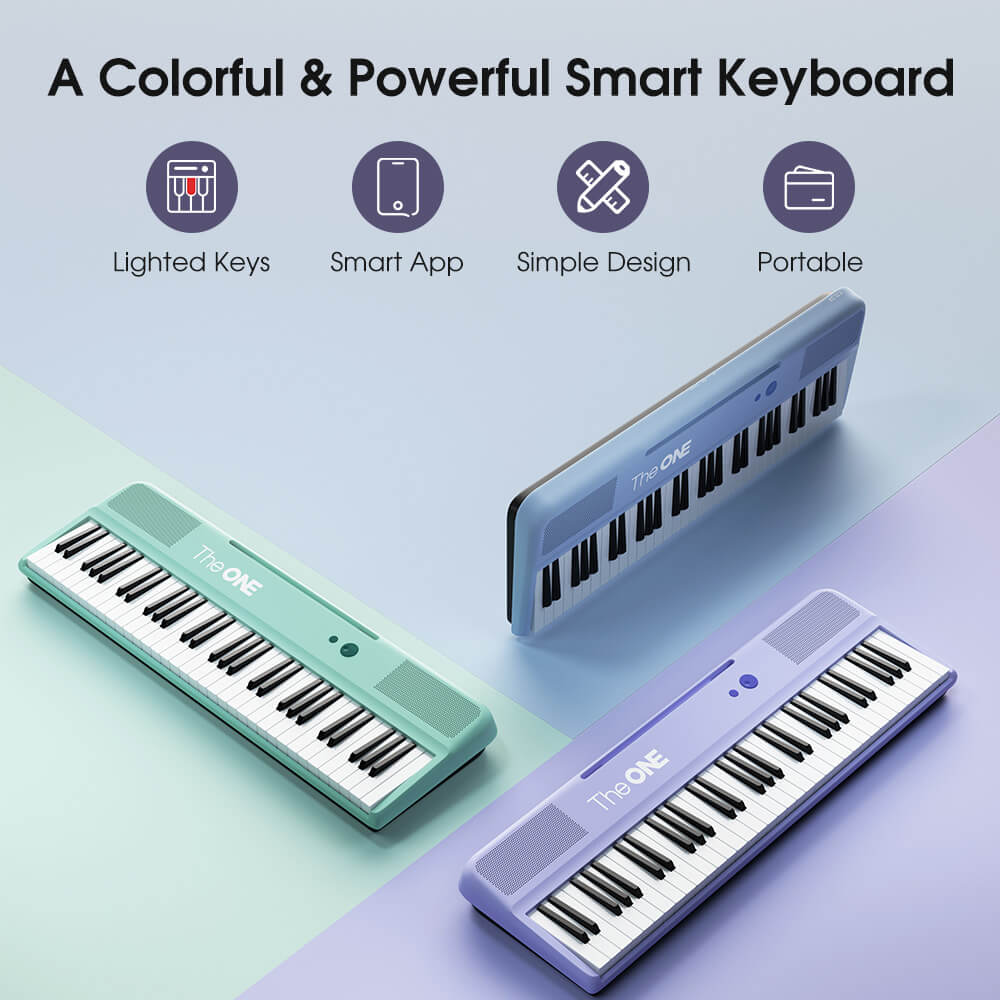
It buys 61 full-size keys, touch response, battery or mains power, and a companion app. On TheONE's site that is the COLOR smart keyboard at $325, with bundle options that add a stand or a bench and rise to $539. What it does not buy is a weighted action, because the mechanism that gives keys weight costs more than the whole budget.
In daily use, that means three things work and one does not. Volume does respond to how hard you press, so expression is available from the first week. The note range covers beginner method books and most pop arrangements. The instrument is light enough, at 7.7 lb, to move between rooms or take on holiday, and it runs on AA batteries as well as a DC 5V cord.
What it cannot do is build finger strength. Touch response changes the sound according to speed, but the key still returns with the same light spring, so the muscles you would use on an acoustic piano are never asked to work. For a first year that is acceptable. If you intend to play graded repertoire, it becomes the ceiling.
Is 61 keys enough to learn piano?
For the first year to eighteen months, usually yes.
Beginner method books and most pop and film arrangements stay inside a 61-key range. What they cannot cover is full-range classical repertoire, which assumes the full acoustic compass.
The practical test is what you intend to play. If the goal is to accompany yourself singing, to play film themes, or to learn chords well enough to sit in with other people, 61 keys removes nothing from the plan and the portability is a real advantage. If the goal is the classical repertoire and graded exams, the missing top and bottom of the range will stop you before your hands do, and you will be buying again within two years. Graded syllabi such as the Royal Conservatory of Music piano levels are a useful way to see how quickly repertoire leaves the beginner range.
There is a middle path worth knowing about. A 61-key instrument bought at $325 can be outgrown rather than regretted: it stays useful as a second instrument, a travel keyboard, or the thing you keep in the bedroom once a larger piano arrives in the living room. Buying it as a permanent solution is the mistake.
What the next step up changes
Weighted keys, and then key count, in that order. The step from a touch-response keyboard to a graded hammer action piano changes how the instrument pushes back against your hand, and that is the physical skill you are building. Everything above that, from speaker quality to cabinet finish, matters once you play daily but rarely decides whether practice happens in month one.
On TheONE's site that step is the PLAY at $1,599, an 88-key graded hammer action piano with four built-in speakers, measuring 54 by 18 by 33 inches and weighing 107 lb. Above it sits the TOP1X at $1,999 and the TOP2 Pro at $2,399, which add cabinet presence and a more refined action rather than a different category of instrument.
If the current budget is fixed, the useful frame is this: the COLOR teaches you notes, chords and rhythm. The PLAY and above teach you piano. Both are legitimate purchases, but only one of them is the last purchase.
| TheONE COLOR | TheONE PLAY | |
|---|---|---|
| Keys | 61 full-size | 88 |
| Key action | Touch response | Graded hammer action, weighted |
| Polyphony | 64 | Not published on the product page |
| Speakers | Built-in | Four Hi-Fi speakers, two 20W tweeters |
| Weight | 7.7 lb (about 3.5 kg) | 107 lb (about 48.5 kg) |
| Power | AA batteries or DC 5V cord | Mains power |
| Price from (US$) | $325 | $1,599 |
What the app includes at this price
Every TheONE keyboard pairs with the Smart Piano app, and the entitlement depends on the model. The COLOR ships with three months of the learning app; the console and upright models ship with six. The app is what turns a budget keyboard into something that teaches, because it marks what you played and slows the tempo when you keep missing the same bar.
Connection is over Bluetooth for iOS 15.6 and Android 7.0 and above, with a cabled USB host option for Android 7.0 and above. At this price the app matters more than the sound library, because a 61-key keyboard with no feedback asks a beginner to be their own teacher on day one. If you later use the keyboard to drive software, it helps to know that MIDI carries performance data rather than audio, so the keyboard can control a computer without making a sound of its own.
What else you will need
A stand and a seat, and the seat matters more than the stand. Playing from a sofa puts the keys too high or too low and makes the hands carry the weight of the arms, which is where tension starts. The TheONE single-X stand for the COLOR is $119 and the double-X version, which fits both the 61-key and 88-key pianos, is also $119. The piano bench is $149, at 22 by 14 by 19 inches with a PU surface and wooden legs.
If you skip any of these, skip the bench first and use a firm chair at the right height. What you should not skip is the height itself, because a keyboard played from the wrong seat is the most common reason a beginner's hands hurt within a fortnight. Long sessions at the wrong height are also the reason the World Health Organization's listening-safety guidance is worth reading alongside your setup: short, comfortable sessions keep both hands and ears in better condition than one long one.

Common mistakes at this budget
The first is buying for the sound list. A keyboard advertising hundreds of tones is not better than one with dozens; the extra voices are a marketing line, and the key action is what you will feel every session. The second is buying a 61-key instrument when graded exams are already planned, which guarantees a second purchase. The third is treating the app as optional, when at this price it is the only source of feedback a beginner has.
Wait instead if your budget can stretch to a used weighted piano in good condition, or if a teacher has specified an instrument. A $500 budget is a genuinely useful starting point, but it is a starting point rather than a destination.
FAQ
Can you get a real piano under $500?
You can get a real instrument, but not weighted keys. Under $500 buys a 61-key keyboard with touch response, which changes volume with how hard you press and covers the first year of beginner material. What it cannot do is train finger strength, because the keys themselves stay light.
Is 61 keys enough to learn piano?
It covers beginner method books and most pop and film arrangements, which is roughly the first year to eighteen months. It does not cover full-range classical repertoire written for the acoustic piano, so if graded exams are the goal the missing keys become the limit before your hands do.
What is the upgrade worth saving for?
Weighted keys, not more sounds. The step from a touch-response keyboard to a graded hammer action piano changes what you can physically learn. On TheONE's site that step runs from the $325 COLOR to the $1,599 PLAY, both at prices checked on 28 September 2026.
What hidden costs come with a budget piano?
A stand and a seat, because playing from a sofa at the wrong height stalls most beginners. The TheONE single-X stand for the COLOR is $119 and the piano bench is $149 as of 28 September 2026. Neither is needed on day one, but both are cheaper than replacing the habit later.
Next step
Decide now whether this is your first instrument or your only one. If it is the first, buy at $325 with a stand and put the difference toward books and time. If it is meant to be the only one, do not buy under $500 at all, because the missing weight in the keys is the feature you will notice every day.
Shipping and returns in short. TheONE ships free within the 48 contiguous United States, with orders usually processed in 1–3 business days and delivery estimated at 3–7 business days after dispatch. International delivery is estimated at 5–15 business days, with shipping and applicable taxes included in the price shown at checkout. Returns within the United States can be requested within 30 calendar days of receipt and require approval.
See the 61-key portable keyboard and the 88-key weighted pianos side by side, with the stands and benches that go with them.
If the reason you are looking under $500 is a small room rather than a small budget, the guide to digital pianos for small apartments deals with size and volume instead.


