
Every listing says "app compatible" and none of them say what happens on Wednesday evening when you sit down. A digital piano with app support can mean anything from a free tuner that opens once to a guided course that marks every mistake you make.
The difference is worth understanding before you buy, because the app is the part of a beginner's instrument that either creates a routine or becomes an icon you never tap. This guide covers what the app genuinely adds, how the two connection methods differ in daily use, and how the included period works on TheONE instruments.
Models and prices referenced here are from TheONE's product pages on 28 September 2026. This is not an independent test.
What "app compatible" usually means
It means the piano can send note data to a phone or tablet. The keyboard itself makes no sound through the app; it reports which keys you pressed, when, and how hard, which is the same MIDI performance data that studio equipment has used for decades.
What the app then does with that data separates the useful implementations from the decorative ones. At one end is a tuner and a metronome. At the other is a guided lesson that slows the tempo when you keep missing the same bar. Both are technically "app compatible", and only one of them substitutes for the person who would otherwise tell you that you played it wrong.
The connection itself is the other variable. A piano that only pairs over Bluetooth is convenient until the pairing drops mid-session. A piano that also offers a cabled USB option gives you a way through. TheONE keyboards support wireless pairing on iOS 15.6 and Android 7.0 and above, with a cable route for Android 7.0 and above using USB host or OTG.
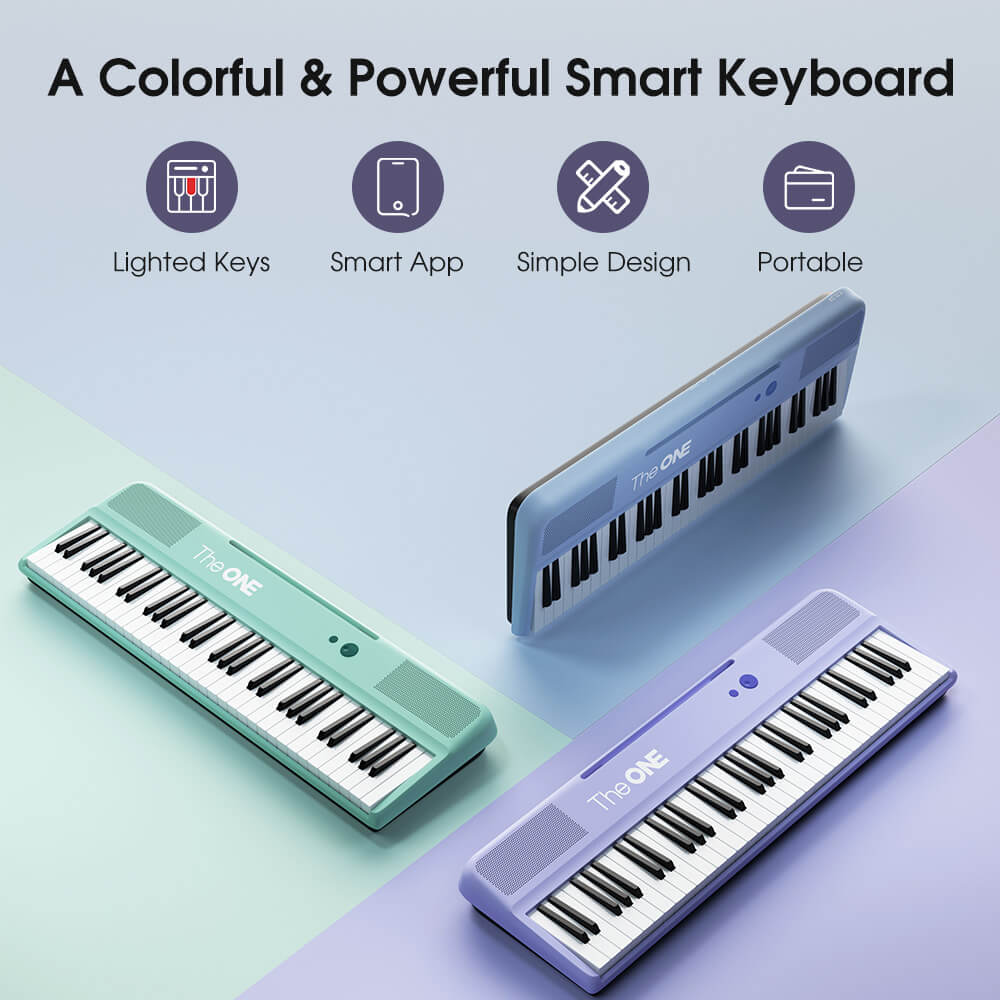
What does a piano app actually add?
Something to play, feedback, and a record of progress.
The feedback is the part that matters, because it is the one thing a beginner cannot provide alone. A library of songs without correction is a playlist you play along to, not a lesson.
In practice the three parts work together. The library removes the question of what to practise, so a session can start in seconds. The feedback closes the loop, marking the note you missed and slowing the tempo until the passage is clean. The progress record is the weakest of the three but the one that keeps adults honest, because it is harder to argue with a streak of unattempted lessons than with a vague sense that you have been practising.
What the app does not add is technique. It knows which notes you played, not whether your hand was tense or your wrist was collapsed. If you are learning without a teacher, the sensible division is that the app handles repetition and the recording of yourself handles the rest. Keep the headphone level low enough to hear a conversation, which is the practical form of the guidance in the NIDCD's material on noise-induced hearing loss and the WHO listening-safety programme.
Is Bluetooth or a cable better for a piano app?
Bluetooth for daily use; a cable as the fallback.
Wireless keeps the piano where it is and removes a lead from the room, which matters more than it sounds in a small flat. Cable wins when pairing misbehaves, and having both means a bad pairing night does not become a lost practice session.
Two practical details decide how pleasant wireless turns out to be. The first is which devices are supported: TheONE keyboards pair on iOS 15.6 and Android 7.0 and above, so an older tablet may need a cable instead. The second is latency, which on a keyboard connection affects the display rather than the sound, because the piano's own speakers are producing the audio.
There is also a limit worth knowing before you rely on the app alone. If the connection drops, you are holding a perfectly good digital piano with no guidance. That is an argument for learning at least one piece without the app from the first month, and for keeping printed music in the house.
Digital piano with app compared
The table sets out what the app adds at each price step, since the included period is not identical across the range. Prices are in US dollars, checked on TheONE's product pages on 28 September 2026.
| TheONE COLOR | TheONE PLAY | TheONE TOP2 Pro | |
|---|---|---|---|
| Keys and action | 61, touch response | 88, graded hammer action | 88, escapement graded hammer action |
| Wireless connection | Bluetooth, iOS 15.6+ and Android 7.0+ | Bluetooth, iOS 15.6+ and Android 7.0+ | Bluetooth, iOS 15.6+ and Android 7.0+ |
| Cabled option | Android 7.0+ with USB host | Android 7.0+ with USB host | Android 7.0+ with USB host |
| Guided keys | Yes, 61 lighted keys | Yes, 88 lighted keys | Yes, 88 lighted keys |
| App time included | Three months | Six months | Six months |
| Price from (US$) | $325 | $1,599 | $2,399 |
Two conclusions follow. First, the connection method should not decide the purchase: all three pair the same way. Second, the choice that matters is the key action, because the app is a service with a time limit and the keys are not. Buying a light action keyboard for the app is like buying a cheap camera for expensive film.
What happens when the included period ends
The instrument keeps working. Sound, response, headphones and connectivity are all independent of the subscription, so the piano you own on month seven is the same instrument it was on month one.
The portable TheONE models include three months of the learning app; the console and upright models include six. After that the guided lessons and the library stop updating until you subscribe. Whether that matters depends on how you use it: a learner who has moved to printed music loses almost nothing, while one who has been following the app as their only source of structure will notice immediately.
The way to avoid the surprise is to treat the included period as a course rather than a facility. Plan what you want to be able to play by the end of it, keep one unguided piece running throughout, and the transition becomes a change of tool rather than a loss of one. Graded material such as the Royal Conservatory of Music levels is a useful continuation once the guided library stops, because it sequences difficulty without needing an app.
FAQ
What does a piano app actually add?
Three things: something to play, feedback on what you played, and a record of progress. The feedback is the valuable part, because it is the bit a beginner cannot supply alone. A song library on its own is a playlist with extra steps.
Is Bluetooth or a cable better for a piano app?
Bluetooth for everyday use, a cable as the fallback. Wireless means no lead across the room and the instrument stays where it is. Cable is more reliable when pairing misbehaves, which is why TheONE keyboards support both, with cabled USB available on Android devices that support USB host or OTG.
What happens when the included app period ends?
The piano keeps working. It still plays through speakers and headphones, still responds to how hard you press, and still connects to other software. You lose the guided lessons and the song library until you choose to subscribe, which is worth knowing before you rely on the app as your only teacher.
Next step
Choose the key action first and the app second, and plan the first three months around the included period rather than assuming it lasts. If you want the app to do most of the teaching, the console and upright models include six months rather than three, which is a real difference for a learner starting from nothing.
Shipping and returns in short. TheONE ships free within the 48 contiguous United States, with orders usually processed in 1–3 business days and delivery estimated at 3–7 business days after dispatch. International delivery is estimated at 5–15 business days, with shipping and applicable taxes included in the price shown at checkout. Returns within the United States can be requested within 30 calendar days of receipt and require approval.
See the app-connected pianos, including which models include six months rather than three.
For how the guidance loop works on the instrument itself, see piano that teaches you how to play. For the difference between a smart piano and a plain digital one, see smart piano vs digital piano.