
The first week is the strange one. You sit down, press a key, the note is correct, and the song is not there yet. Meanwhile every product page you open is shouting about polyphony, sampling rates and voice counts, none of which answers the question that decides whether you keep playing.
Choosing a digital piano for beginners comes down to two failures you are trying to avoid. One is an instrument so limited that you outgrow it in a season. The other is an instrument so expensive that you feel guilty every time you walk past it. Both are avoidable once you know which four specifications change how fast a beginner improves.
The models compared in this guide are TheONE's own products, and every specification and price below was taken from TheONE's product pages on 28 September 2026. Nothing here is an independent test result.
Digital piano for beginners: the short answer
Buy the key action first, the key count second, and the sound third. Everything else on a spec sheet is decoration until those three are right, because the way a key resists your finger is the skill you are actually building. A modestly priced 88-key piano with weighted keys will teach you more in a year than a feature-stuffed keyboard with a light, springy touch.
The shortest version: choose 61 keys with touch response if your budget is tight and your space is small. Choose 88 weighted keys if you already know you want classical repertoire or graded exams. On either one, treat the companion app as the thing that turns practice into something you do rather than something you intend to do.
Is a digital piano good for beginners?
Yes, it usually suits beginners better than an acoustic.
For a first instrument, the practical wins usually outweigh the tonal difference: headphones at midnight, no tuning, and a footprint that fits a flat. Choose acoustic first only if the tone itself is the point.
What makes a digital piano workable for a beginner is not the number of sounds. It is whether the keys resist your fingers predictably, and whether you can sit down at it for twenty minutes without rearranging the room. Digitals also solve the problem that stops more beginners than motivation does: embarrassment. Headphones mean nobody in the next room hears the wrong notes, so you practise the bar you keep fumbling instead of skipping past it.
The trade-off is feel and service life. An acoustic piano holds its value, and its touch is the reference point every digital model is imitating. At beginner level a digital uses sensors and speakers instead of hammers and strings, so the touch is an approximation and the electronics will eventually feel dated. For a first three years of learning that approximation is close enough, and the convenience is what keeps the habit alive.
What does a beginner actually need in the first 90 days?
A keyboard, a correct seat height, and a daily routine.
Month one is note-finding and hand shape, month two is two hands doing different jobs, and month three is a piece that finally sounds like music. Nothing in that sequence needs a full-range instrument, an exam syllabus or a metronome with fourteen settings.
Month one is geography and hand shape. You learn where C is, how curved fingers sit on the keys, and how to play five notes with each hand without tension. Month two adds coordination: two hands together on simple chord shapes, and a melody played against a held bass note. Month three is where a first piece starts to sound like music, because you can play a section slowly without stopping at every bar line.
Two things shorten those months. The first is instant feedback, which is why a keyboard that lights the next key helps through the earliest weeks, when the gap between hearing a song and playing it feels enormous. The second is sitting position: feet flat, bench at a height where your forearms sit roughly level with the keys, and enough distance that your elbows are not pinned to your ribs.
If you are buying for a child, scale the setup down rather than the instrument. A stool that puts a six-year-old at the right height, and a stand that adjusts as they grow, will do more for their playing than a more expensive keyboard played from the wrong height.
How much practice per day does a beginner need?
Fifteen focused minutes daily beats two hours on Sunday.
For most beginners, fifteen to twenty minutes a day, six days a week, is enough to see visible progress within three months. Frequency matters more than duration, because the skill consolidates between sessions rather than inside one long one.
A workable fifteen minutes looks like this: three minutes on a warm-up you can already play, seven on the one passage that is currently failing, and five playing something you enjoy. If you have more time, repeat that shape instead of extending the blocks. Stop while your hands still feel easy, because tension at the end of a session is what makes tomorrow harder.
Use headphones for late sessions, but mind the level. Listening at high volume for long periods is the mechanism behind hearing damage from personal audio, which is why the World Health Organization runs a listening-safety programme and the NIDCD publishes guidance on noise-induced loss. Keep the volume where you could still hear someone speaking to you, and take a short break every half hour.
Can you learn piano without a teacher?
Yes, for the first year, if something corrects you.
Self-teaching works at beginner level when you get feedback on two things: the right notes at the right time, and whether your hands are tense. An app or a light-guided keyboard covers most of that in the first year.
What self-teaching tends to miss is not information but correction. Nobody is there to say that your left hand is rushing, or that you have been practising a passage with the wrong fingering for a fortnight. Build the correction in deliberately: record yourself once a week, play slowly enough that a mistake is obvious, and go back to the fingering printed on the page instead of inventing one that feels easier.
Where a teacher earns the fee is interpretation: shaping dynamics, phrasing, and choosing repertoire that stretches you without breaking you. If lessons are not possible yet, use a graded syllabus such as the Royal Conservatory of Music piano levels as a rough map of what comes next, then let the app keep the daily sessions honest.
The decision criteria that actually matter
Four specifications change how a beginner's instrument feels within the first month. Everything below them on a product page, from orchestral voices to drum kits, is a preference rather than a requirement. Judge candidates on these four in order and the shortlist builds itself.
- Key action. Weighted, and ideally graded hammer action, means the lower keys feel heavier than the upper ones, the way hammers and strings behave inside a real piano. A touch-response keyboard changes volume with speed but the key itself stays light.
- Key count. 61 keys covers beginner method books and most pop and film arrangements. 88 keys covers full-range classical repertoire written for the acoustic piano.
- Sound you will actually hear. Speakers and headphones matter more than the tone engine at this price, so a model with a real speaker system is easier to live with.
- How you connect. Look for both wireless and cabled options: Bluetooth for app pairing, and USB for the sessions when pairing misbehaves.
Then translate the numbers before you compare them. Polyphony tells you how many notes can ring at once, so 64 voices is enough for beginner repertoire played with the sustain pedal. A graded hammer action describes resistance, not sound quality, which is why it is the one line worth reading twice. And if a listing mentions MIDI, remember that MIDI carries performance data rather than audio, so a controller can drive software without making a sound of its own.
| What the listing says | What it means when you play |
|---|---|
| Polyphony 64 | Roughly 64 notes can sound at once, including ones still ringing out. Enough for beginner pieces played with the sustain pedal. |
| Graded hammer action | The lower keys feel heavier than the higher ones, so your hand learns the resistance of a real piano rather than a spring. |
| Touch response | Harder presses sound louder. Useful for expression, but it does not train finger strength, because key weight stays the same. |
| 16-bit stereo sampling | The notes were recorded and play back as stereo audio. What you hear depends mostly on the speakers you play through. |
| Bluetooth for iOS 15.6+ and Android 7.0+ | You can pair the keyboard with the app wirelessly on current phones and tablets, with no cable. |
| Battery power | The keyboard can leave the wall socket. On a 61-key portable model, that is what makes playing in another room realistic. |
Which digital piano sounds most like a real piano?
The one with the speakers you will play through daily.
At beginner prices, the speaker system and your room make more difference than the tone engine. Two pianos using the same class of recorded grand samples can sound completely different through different cabinets.
Underneath the speakers the mechanism is straightforward. Makers record a grand piano note by note, at several dynamics, then play the matching recording back when you press a key. Higher sampling rates and more velocity layers make the transition between soft and loud playing smoother, which is why a model with a 44.1 kHz sample rate and a clean headphone output often feels more convincing than budget hardware with a longer feature list.
If you always practise on headphones, judge the instrument on its headphone output and take your own pair to the shop. If you play for other people, judge it on the speakers at the volume you will actually use. And if you want the tactile half of "real", compare key return rather than tone, because that is what makes fast repeated notes feel possible.

Beginner digital pianos compared
Below are the three most common starting points side by side: a portable 61-key keyboard, an 88-key weighted home piano, and a weighted model built to sit in a living room. Prices are in US dollars, checked on TheONE's product pages on 28 September 2026; bundles that add a stand or bench cost more than the figures shown.
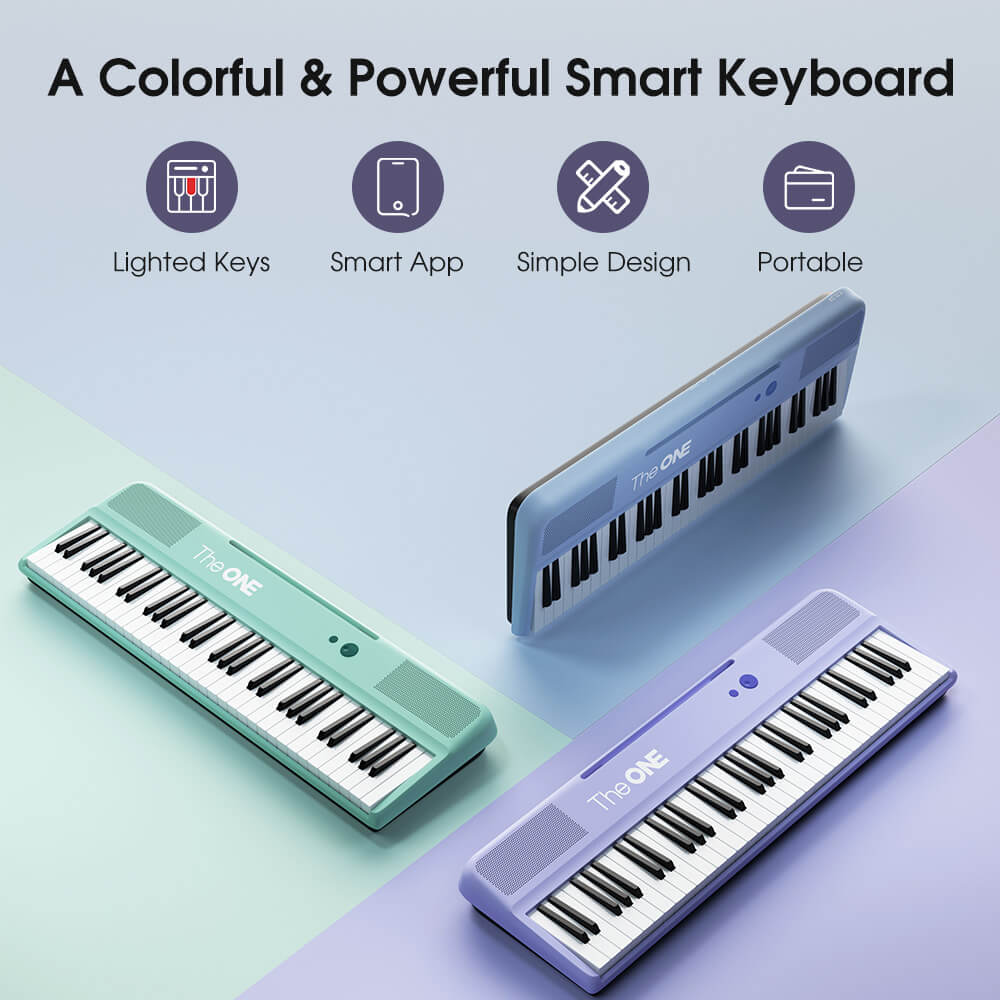
| TheONE COLOR | TheONE PLAY | TheONE TOP1X | |
|---|---|---|---|
| Keys | 61 full-size | 88 | 88 |
| Key action | Touch response, light keys | Graded hammer action, weighted | Graded hammer action, weighted |
| Polyphony | 64 | Not published on the product page | Not published on the product page |
| Speaker system | Built-in speakers | Four Hi-Fi speakers, two 20W tweeters | Dual 20W tweeters plus dual speakers |
| Weight | 7.7 lb (about 3.5 kg) | 107 lb (about 48.5 kg) | Not published on the product page |
| Power | AA batteries or DC 5V power cord | Mains power | Mains power |
| Best for | The first six months, small flats, playing on the move | A beginner who wants piano feel and a permanent spot for it | A player who wants a home piano that looks like furniture |
| Price from (US$) | $325 | $1,599 | $1,999 |
Read the table by elimination rather than by ranking. If a full-size 88-key piano will not fit, or you need to carry it, the COLOR is the only one of the three that solves your problem. If you want real key resistance and have a permanent spot for a 107 lb instrument, the PLAY is the sensible entry to weighted keys. The TOP1X makes sense when the piano is also a piece of furniture in a shared room.

What is the best affordable digital piano for beginners?
Buy the cheapest model whose key action you can live with.
Work out what the cheapest option that solves your two hard constraints costs, then ask whether the next step up buys real key action or only more features. In this range that line sits between touch response and weighted keys.
That is the upgrade worth paying for. Above it, more money buys better speakers, a heavier cabinet and a more refined action, which matter once you play daily but rarely decide whether you stick with it in month one. Below it, the savings are real and the compromise is specific: light keys build less finger strength, and fewer keys put some repertoire out of reach.
Two costs are easy to forget. You will want a stand at the right height and a bench rather than a dining chair, and both add to the total. On TheONE's site the adjustable double-X stand is $119 and the piano bench is $149 as of 28 September 2026. Neither is required on day one, but playing a new piano from a sofa is one of the most common ways a habit stalls in week three.
Common first-piano mistakes
Almost every avoidable beginner purchase follows the same pattern: the buyer optimises something visible instead of something felt. Three of these recur often enough to name, and all three cost more to fix later than to avoid now.
The first is buying a keyboard for the sound list and ignoring the key action; the instrument then feels like a toy within a month, and the beginner blames themselves rather than the keys. The second is buying 88 keys when the piano has nowhere to live, because an instrument that has to be packed away after each session gets played far less than one that stays ready. The third is treating the app as optional: on a smart piano it supplies the feedback a beginner cannot give themselves, and skipping it turns a teaching instrument back into a silent keyboard.
This guide is written for people starting from zero, returning after years away, or buying for a child who has asked for lessons. It also fits anyone in a flat or shared house where volume and space are real constraints, and anyone who can only practise at night.
Wait instead if you have already decided the acoustic tone is the point, if a teacher has specified an instrument, or if you are buying for an exam candidate whose syllabus names a particular action and range. In those cases someone with more information than a buying guide has already made the decision.
FAQ
Is a digital piano good for beginners?
Yes, for most beginners a digital piano is the more practical first instrument. It stays in tune, can be played through headphones, and takes up far less room than an acoustic upright. The main thing to check is the key action: a model with weight in the keys feels closer to an acoustic piano and will not have to be replaced as your hands develop.
How much should a beginner spend on a digital piano?
First-year players usually spend between a few hundred and about fifteen hundred dollars. Under $500 buys a portable 61-key keyboard with a light touch, which is enough to learn notes, chords and rhythm. If your budget allows a weighted 88-key model, you avoid buying twice, because the same instrument carries you through graded repertoire. Spend on the key action before you spend on extra sounds.
Do I need 88 weighted keys to start learning piano?
No, not on day one, but it depends on your goal. A 61-key keyboard covers the pieces most adult and child beginners meet in the first year, and it is far easier to move around a small home. If you already know you want to play full-range classical repertoire, or you are buying for someone who will take graded exams, start with 88 weighted keys so the instrument does not become the reason you stop.
What if the piano arrives damaged, or I change my mind?
Inspect the box when it arrives and report shipping damage as soon as you can, ideally within 24 hours, with photos or a video of the fault. Orders delivered in the United States can be returned within 30 calendar days of receipt, and returns need approval before you ship the item back. Non-quality returns are charged the return shipping cost plus a 5% handling fee. Piano and drum performance defects carry a 12-month limited warranty.
Next step
Pick the constraint you cannot change, the space you have or the repertoire you want to play, and let it choose for you. A small room or a piano that travels points to a portable 61-key keyboard. A permanent spot in the home points to 88 weighted keys, which skips the upgrade later.
Shipping and returns in short. TheONE ships free within the 48 contiguous United States, with orders usually processed in 1–3 business days and delivery estimated at 3–7 business days after dispatch. International delivery is estimated at 5–15 business days, with shipping and applicable taxes included in the price shown at checkout. Returns within the United States can be requested within 30 calendar days of receipt and require approval. Piano and drum performance defects are covered by a 12-month limited warranty, with 12 months on power cords and 6 months on cables.
Compare the full beginner range, including the 61-key portable and the 88-key weighted pianos, on one page.
If you want a second opinion before you commit, the guide 61 keys vs 88 keys covers the range question in more depth, and the gear match quiz turns four questions into a shortlist in about a minute.