
Search for the best smart piano for beginners and you get a wall of models, each described as ideal for someone starting out. The models genuinely differ, but almost none of the differences matter in the first month. Two of them decide everything.
Those two are whether the instrument has to move, and whether graded exams are on the plan. Answer both and the shortlist collapses to three models. This guide sets out the shortlist, what each one gives a beginner, and the specifications that are worth ignoring while you decide.
Every piano compared here is a TheONE product, and the specifications and prices below were taken from TheONE's product pages on 28 September 2026. This is not an independent test.
What a beginner actually uses in the first month
Two things: the keys under the hands and the guidance that tells them what to play. Everything else — the speaker count, the number of instrument voices, the finish of the cabinet — either supports those two or waits until later.
The keys matter because they are the part that cannot be upgraded. If the action is light and springy, a beginner learns to press rather than to play, and that habit has to be unlearned on a different instrument later. Keep headphone volume at a level you could still talk over, because cumulative exposure is what the NIDCD guidance on noise-induced hearing loss describes and the WHO listening-safety programme is built around. The guidance matters because it removes the two delays that make early practice feel pointless: finding the right note, and keeping time while looking for it.
What is genuinely ignorable at this stage is the specification list beneath those two. A model with 426 tones and one with 256 will feel identical to a beginner playing a five-finger exercise, and the app's song count matters far less than whether the app marks which bar you got wrong. That marking works because the keyboard sends each note as MIDI performance data over Bluetooth, rather than streaming audio. If a listing leads with content volume and says nothing about key action, keep reading elsewhere.
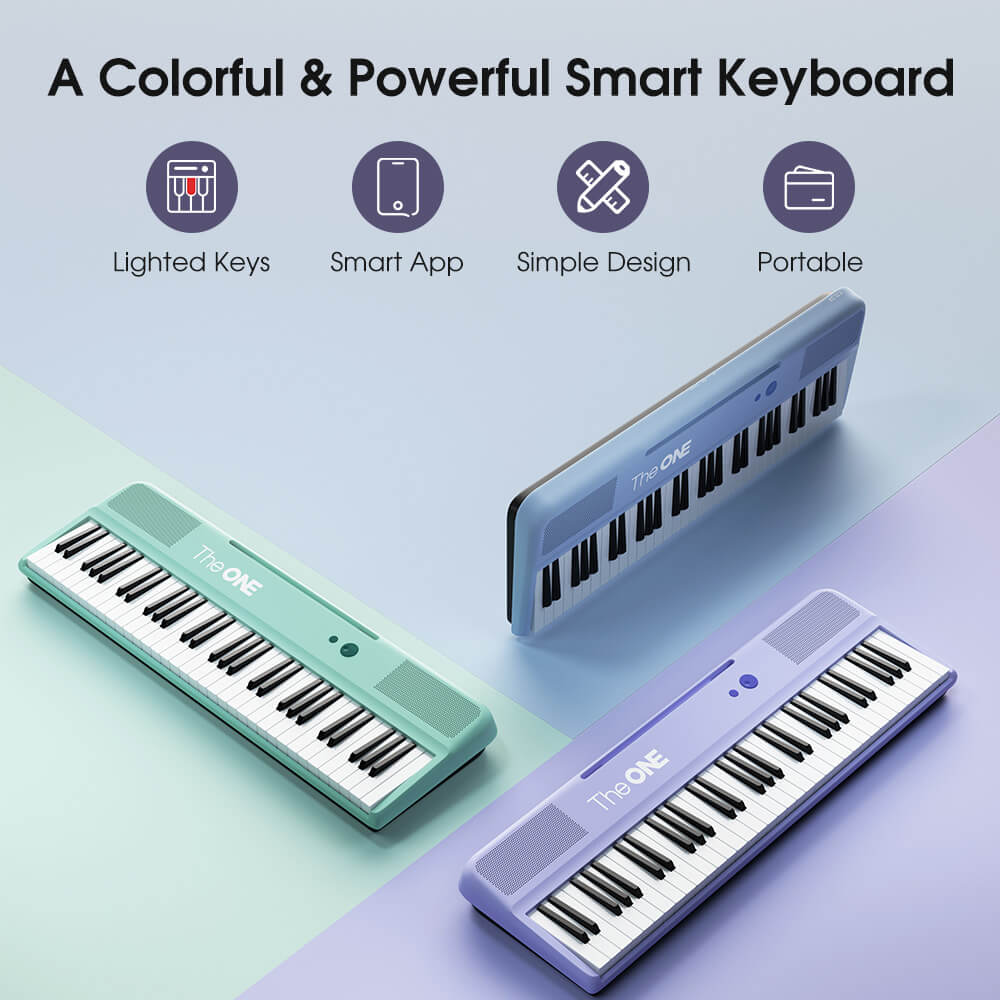
What is the best smart piano for a beginner?
The 61-key COLOR at $325, or the weighted PLAY at $1,599.
That is the honest shortlist. The COLOR answers portability and price; the PLAY answers weighted keys and does not need replacing. Everything above the PLAY buys cabinet and refinement rather than a different category of instrument.
The reasoning is about permanence rather than quality. A beginner's first instrument has one job, which is to be played often. If the room cannot host a 107 lb piano, buying one produces an instrument that is admired rather than used, and the $325 portable that sits on a stand and gets played daily is the better purchase by a wide margin. If the room can host it and the player is committed, the reverse is true: buying the light-action model first usually means buying again within two years.
The middle of the range is where beginners overspend. A model at $1,119 to $1,349 such as the Sing Pro is a genuine 88-key weighted instrument, and it is the right answer for a specific person: someone who needs a portable piano with weighted keys, usually because they perform or travel. For everyone else the choice is between the two ends.
Do beginners need 88 weighted keys on a smart piano?
Not on day one, but they cannot be added later.
A 61-key touch-response keyboard teaches notes, chords and rhythm. A graded hammer action teaches how a piano answers your hand, which is the skill that transfers to every other piano you will ever play.
The practical test is the repertoire. Beginner method books and most pop arrangements stay inside 61 keys, so a portable keyboard is not a compromise for the first year. Full-range classical repertoire assumes the whole compass, and graded exams follow that repertoire, which is why a learner heading towards exams should start at 88 keys. Graded material such as the Royal Conservatory of Music levels makes that requirement concrete. The deeper version of that comparison is in digital piano for beginners.
One detail worth knowing before you assume a 61-key model will feel like a toy: the keys are full-size, and the playing experience is genuine. The difference is resistance, not size. A beginner cannot feel that difference in the shop; they feel it after three months, when the passages they want to play start asking the hands to carry weight.
Smart pianos for beginners compared
Three models cover the realistic options, and the fourth column shows what the step beyond them buys. Prices are in US dollars, checked on TheONE's product pages on 28 September 2026.
| TheONE COLOR | TheONE Sing Pro | TheONE PLAY | |
|---|---|---|---|
| Keys | 61, lit | 88, lit | 88, lit |
| Key action | Touch response | Weighted | Graded hammer action, weighted |
| Weight | 7.7 lb (about 3.5 kg) | Portable 88-key frame | 107 lb (about 48.5 kg) |
| Power | AA batteries or DC 5V cord | Mains power | Mains power |
| App time included | Three months | Three months | Six months |
| Best for | A first instrument in a small room | A portable piano with weighted keys | A permanent home piano |
| Price from (US$) | $325 | $1,119 | $1,599 |
Buy from this table by eliminating, not by comparing. Remove any model that cannot live where the player practises, then remove any model whose key action will not carry the repertoire the player wants. What remains is the answer, and in most households it is a single row.

What to ignore while you choose
Ignore the tone count first. A beginner uses a handful of piano voices, and the difference between 256 and 426 is not audible while learning a five-finger exercise. Next, ignore any claim about sound quality that is not specific: "rich, immersive sound" is a phrase, while "four speakers with two 20W tweeters" is a specification you can compare.
Then ignore the included content for long enough to check the entitlement. The portable TheONE models include three months of the learning app and the console and upright models include six. That difference is a real purchasing factor for a learner starting from nothing, and it is easy to miss when the marketing focuses on song numbers instead.
Finally, ignore the assumption that you must buy everything at once. A stand is essential from day one; a bench is close behind, because playing from the wrong seat is the fastest way to make the hands tense; pedal can wait until the first pieces need connected sound. The piano bench height guide explains the setup part in detail.
FAQ
What is the best smart piano for a beginner?
If the piano has to move, the 61-key TheONE COLOR at $325 is the sensible starting point. If it has a permanent home, the 88-key weighted PLAY at $1,599 is the one that will not need replacing. Everything in between is a compromise between those two constraints.
Do beginners need 88 weighted keys on a smart piano?
Not on day one, but weighted keys are the part you cannot add later. A 61-key touch-response keyboard teaches notes and rhythm; a graded hammer action teaches how a piano responds to your hand. If graded exams are on the plan, start at 88 keys.
How long do you get the learning app for?
It differs by model. On TheONE instruments the portable models including the COLOR and Sing Pro include three months of the learning app, while the console and upright models including the PLAY, TOP1X and TOP2 Pro include six, as of 28 September 2026.
Next step
Write down where the piano will live and what you want to play in two years. Those two lines pick the row from the table above, and the rest of the specification list stops mattering. If you are still unsure, the cheaper portable option is the safer mistake to make.
Shipping and returns in short. TheONE ships free within the 48 contiguous United States, with orders usually processed in 1–3 business days and delivery estimated at 3–7 business days after dispatch. International delivery is estimated at 5–15 business days, with shipping and applicable taxes included in the price shown at checkout. Returns within the United States can be requested within 30 calendar days of receipt and require approval.
See the beginner range with the key action and app entitlement for each model listed side by side.
If you are choosing between lit keys and printed labels, see light up keyboard piano. If the budget is fixed under $500, best digital piano under $500 covers what that buys.


