
You have seen the videos: the keys glow, a hand follows them, and a recognisable tune appears in the first minute. Buying a light up keyboard piano on the strength of that video alone is how people end up with an instrument whose lights stop mattering in week three — or one that never quite plays the notes the app expects.
The lights are real, and they do one job well. What decides whether the purchase works is what sits underneath them: the key action, the key count and how the keyboard talks to the app. This guide covers those in the order that matters, plus the limits of guided playing that the videos never mention.
The models referenced here are TheONE products, with specifications and prices taken from TheONE's product pages on 28 September 2026. This is not an independent test.
What the lights are actually doing
Every key carries its own light, and the app tells the keyboard which one to illuminate next. That is why the guidance works without a screen: the instruction appears on the instrument itself, exactly where your hand is about to go.
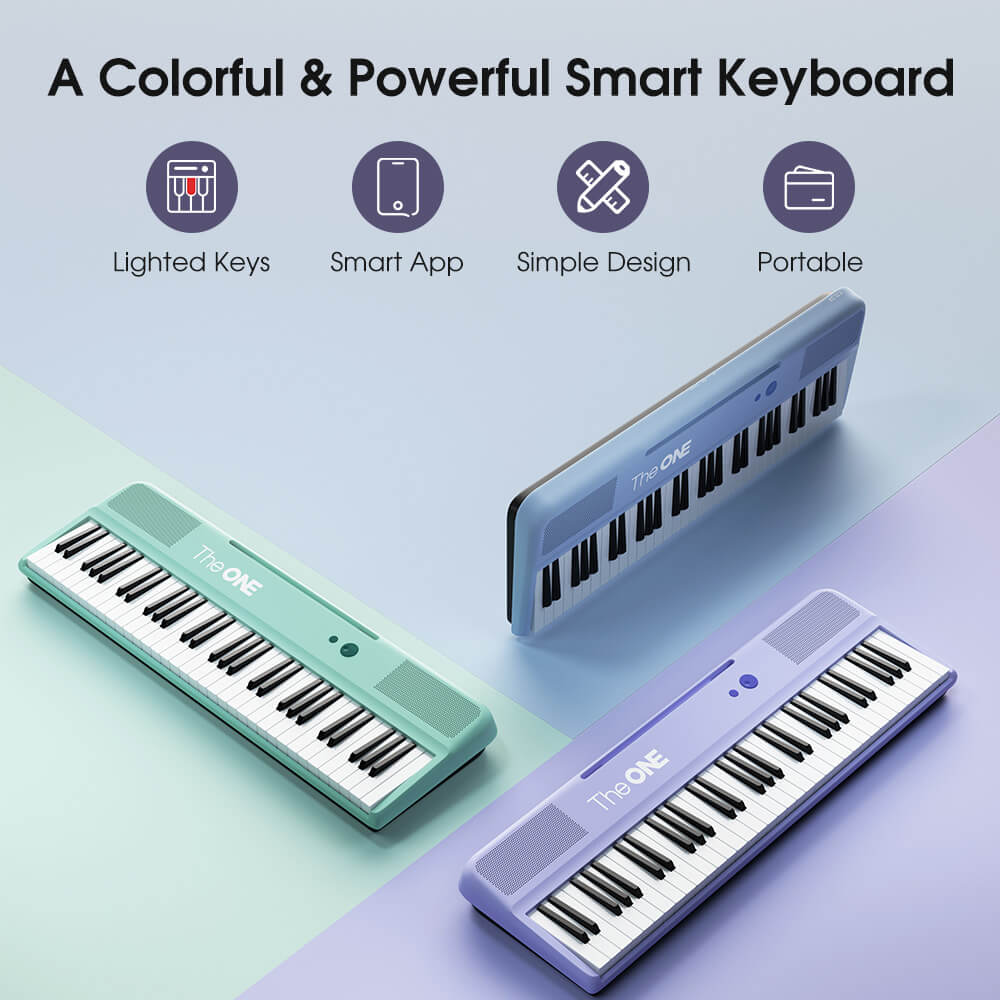
Two details separate a good implementation from a poor one. The first is whether all the keys light or only some — the TheONE COLOR lights all 61 of its keys, and the 88-key models light the full range. The second is colour: the TheONE Sing Pro uses red and blue so the two hands can be distinguished at a glance, which matters as soon as you play hands together rather than one at a time.
What the lights do not do is listen. That job belongs to the app, which receives each note through MIDI performance data rather than audio, so it can mark the specific note you missed instead of telling you that something went wrong. That data travels over Bluetooth on iOS 15.6 and Android 7.0 and above, with a cabled USB option on Android devices that support USB host. The practical effect is that the loop closes without a teacher: see the light, press the key, read the correction.
How do light up keyboard piano keys work?
Each key has its own light, driven by the app.
The app sends which note comes next, the key glows, and you press it. Because the instruction sits under your hand, you can play a tune in the first session without reading music at all.
The mechanism is worth understanding before you compare models, because it explains both the benefit and the limit. The app is receiving note, timing and velocity data from the keyboard, comparing it with the score, and returning a lighting command. Nothing about that loop is audio, which is why the guidance keeps working with the volume down or headphones in.
It also explains why the feature fades in importance. Once you can find a note without looking, the light is confirming something you already know, and the useful part becomes the error marking rather than the illumination. That transition usually happens within a month for an adult and a little later for a child, and it is the reason the key action underneath matters more than the glow above it.
Is 61 keys or 88 keys better for a light up keyboard?
61 keys for portable use; 88 for graded repertoire.
61 keys covers beginner method books and most pop arrangements, and keeps the instrument light enough to move. 88 keys covers full-range classical music and will not need replacing if exams are on the plan.
The decision is mostly about the room and the ambition, not the lights. A 61-key model such as the COLOR weighs 7.7 lb and can sit on a stand, a desk or a bed, which is why it suits a shared flat or a child's bedroom. An 88-key model such as the PLAY weighs 107 lb, measures 54 by 18 by 33 inches and needs a permanent spot.
If you are unsure, ask which instrument you will still want in two years. For a learner who intends to play film themes and accompany themselves singing, 61 keys is not a compromise. For a learner heading towards graded exams, the missing octaves become the limit before the lights stop helping, and buying twice costs more than buying the 88-key model once.
Light up models compared
The table below sets out the four models whose keys light up, from the portable entry point to the cabinet piano. Prices are in US dollars, checked on TheONE's product pages on 28 September 2026.
| TheONE COLOR | TheONE PLAY | TheONE TOP1X | |
|---|---|---|---|
| Keys | 61, lighted | 88, lighted | 88, lighted |
| Key action | Touch response | Graded hammer action, weighted | Graded hammer action, weighted |
| Weight | 7.7 lb (about 3.5 kg) | 107 lb (about 48.5 kg) | Not published on the product page |
| App time included | Three months | Six months | Six months |
| Best for | First instrument, small rooms, travel | A learner who wants piano feel at home | A home piano that looks like furniture |
| Price from (US$) | $325 | $1,599 | $1,999 |
Read the table by elimination. If the keyboard has to move, only the COLOR answers that. If it stays in one place, buy the weighted action now: the graded hammer mechanism is the part you cannot add later, and it is what turns guided note-finding into actual piano technique. If you want the two-hand colour guidance, the Sing Pro at $1,119 is the 88-key weighted model that uses red and blue lights.

Do light up keyboards cost more?
Not usually at the entry level.
The lights are part of how the key assembly is built rather than a separate module, so a light-up keyboard and a comparable plain keyboard land at similar prices. What moves the price is the action and the cabinet.
That has a useful consequence for buying: you can stop comparing models on whether they glow and start comparing them on what they feel like. Two light-up keyboards at the same price can differ completely in key resistance, and the one with the graded hammer action is the one that will still be useful when the lights are switched off.
One cost is easy to miss. The guided content is included for a limited period — three months on TheONE's portable models, six months on the console and upright models — and after that the keyboard keeps working normally while the guided library stops updating. Plan the first months accordingly rather than assuming the app is permanent.
What the lights cannot do
They cannot hear whether your playing sounds musical. The app knows which notes you played and when, and nothing about tone, phrasing or whether your shoulders had risen by the end of a phrase. Those still need a teacher's ear, or a recording of yourself played back.
They also cannot decide what to learn next beyond the beginner stage. A song library is ordered by what people want to play; a method book is ordered by how hands develop. Use the lights to get through the first months, then bring in graded material from a body such as the Royal Conservatory of Music so that your reading keeps pace with your fingers.
And they do not remove the need for correct posture. If the keyboard sits at the wrong height, the lights will still guide you accurately to a position that hurts. Short sessions help for the same reason the WHO listening-safety guidance focuses on duration rather than peaks: what you repeat daily is what shapes the habit. Twenty minutes at the right height beats an hour at the wrong one.
FAQ
How do light up keyboard piano keys work?
Each key carries its own light under the surface, and the app tells the keyboard which one to illuminate next. You follow the glow instead of reading a score, so the rhythm stays intact while you are still learning where the notes live. The lights are hardware, not a phone screen.
Is 61 keys or 88 keys better for a light up keyboard?
61 keys suits a portable first keyboard and covers beginner method books. 88 keys covers full-range classical repertoire and is the right choice if the same instrument has to last through graded exams. On TheONE models the 61-key COLOR starts at $325 and the 88-key PLAY at $1,599.
Do light up keyboards cost more than standard ones?
Not usually at the entry level, because the lights are part of the key assembly rather than an add-on. Price differences between two light-up keyboards come from key action, speaker system and cabinet, not from whether the keys glow.
Next step
Decide two things before you compare models: whether the keyboard has to move, and whether graded repertoire is the goal. Those two answers pick the key count, and the key count picks the shortlist. Then choose the best action within it, because that is the part you keep after the lights stop being the interesting part.
Shipping and returns in short. TheONE ships free within the 48 contiguous United States, with orders usually processed in 1–3 business days and delivery estimated at 3–7 business days after dispatch. International delivery is estimated at 5–15 business days, with shipping and applicable taxes included in the price shown at checkout. Returns within the United States can be requested within 30 calendar days of receipt and require approval.
See the light up keyboards, from the portable 61-key model to the weighted home pianos.
If you want the mechanism in more depth, piano that teaches you how to play explains how the guidance loop works. For the wider first-purchase decision, start with digital piano for beginners.


