
The phrase sounds like a claim from a shopping page. A piano that teaches you how to play, without a teacher, without music reading, from the first evening. Either it is a gimmick or something specific is happening inside the instrument, and the difference matters when you are spending hundreds of dollars on the promise.
Something specific is happening. A teaching piano closes a loop that a silent keyboard leaves open: it shows you what to play, notices what you played, and adjusts until the two match. That loop is what a teacher runs in a lesson, and understanding how it works tells you both what the instrument can replace and what it cannot.
The models referenced here are TheONE products, and the specifications and prices below were taken from TheONE's product pages on 28 September 2026. This is not an independent test.
What separates a teaching piano from a silent keyboard
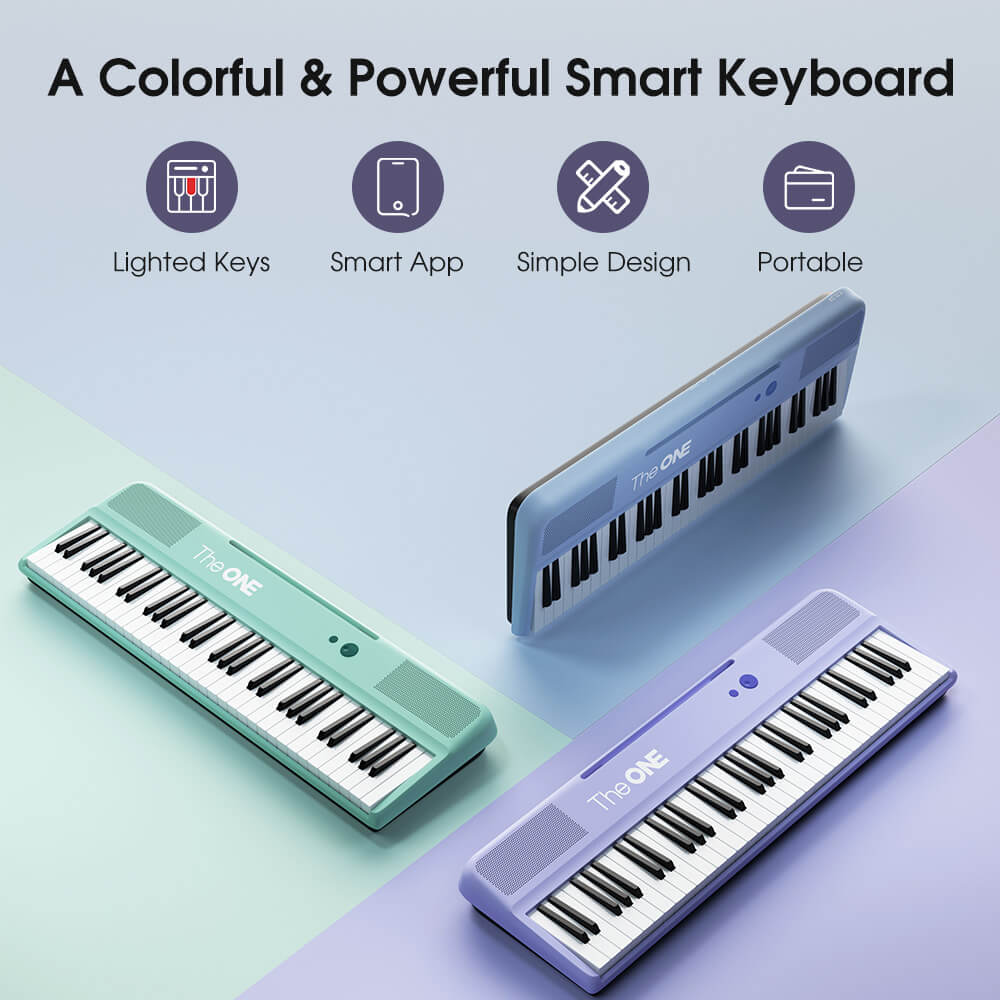
Two capabilities, and neither is about sound. The first is showing the next note on the instrument itself, which on TheONE instruments means 61 or 88 individually lit keys. The second is knowing which notes you actually played, transmitted as performance data rather than audio.
The second capability is the less obvious one. When you press a key, the piano sends the app a note, a timing and a velocity, which is what MIDI data describes rather than a recording of sound. Because the app receives exact information, it can mark the specific note you missed in the specific bar, instead of telling you that something went wrong somewhere. That data travels over Bluetooth on iOS 15.6 and Android 7.0 and above, with a cabled alternative on Android devices that support USB host.
A silent keyboard does neither. You press a key, you hear a piano note, and only your own ear tells you whether it was the right one. For a beginner in the first weeks, that is often not enough — not because they cannot hear a wrong note, but because they cannot yet tell whether they are playing the right one slowly, which is a different problem from playing it badly.
How does a piano teach you to play?
It shows the next note and marks what you missed.
The lights give you the answer before you look for it, and the app slows the tempo until the mistakes stop. Between those two, the practice loop closes without an adult watching.
In a session, the sequence runs like this. The app plays a phrase, or you choose a lesson. The keys light in order. You follow, and the app records whether each note landed on time. Where you fail repeatedly, the tempo drops, and the passage repeats until it is clean. That is almost exactly the structure a teacher uses in the first year, minus the judgement about how it sounded.
What this changes is not the ceiling but the floor. A beginner who can run a productive fifteen minutes without supervision is far more likely to practise on a Tuesday evening than one who needs to assemble a lesson plan first. The instrument does not make you a better pianist than a teacher would; it removes the excuse that there is nothing to practise.
Do light-up keys work for adults?
Yes. The difference is what you do after them.
Adults learn to find notes by sight faster than children, so the lights are useful for weeks rather than months. After that they are best used as a check on difficult passages rather than as the main way to learn.
The risk adults face is different from the one children face. A child following lights is learning the geography of the keyboard at an age when that is the bottleneck. An adult following lights is often delaying the skill they actually need, which is reading notation well enough to practise material the app does not contain. If your intention is to play from sheet music, treat the lights as scaffolding and start reading in parallel from the first month.
A useful routine is to learn a new piece with the lights on, then play it again with them off the following day. Graded material from a body such as the Royal Conservatory of Music is a reasonable way to keep that second half honest, because it gives you something to read rather than something to follow.
What a teaching piano cannot do
It cannot hear phrasing, tone or posture. It knows which notes you played and when, and it knows nothing about whether the result sounded musical or whether your shoulders had risen by the end of the phrase. Those need a teacher's ear or a recording of yourself.
It also cannot decide what you should learn next at the level above beginner. Method books are sequenced by someone thinking about hand development; a song library is sequenced by what people want to play. Both are useful, and for the second and third year the difference starts to matter, which is the point at which a fortnightly lesson becomes worth the money even if the piano is doing most of the daily work.
The third limitation is physical. Guidance tells you where to press, not how. If you play with a flat hand and a locked wrist, the app will report that you played all the right notes, and it will be correct. Keeping the volume at a level you could still talk over is worth doing for the same reason: the NIDCD's guidance on noise-induced hearing loss and the WHO listening-safety programme both treat long exposure as the risk, and daily practice is exactly that.
Teaching pianos compared
The three models below cover the range of what a teaching piano can be, from a portable 61-key starting point to a weighted home instrument. Prices are in US dollars, checked on TheONE's product pages on 28 September 2026.
| TheONE COLOR | TheONE PLAY | TheONE TOP1X | |
|---|---|---|---|
| Keys | 61 full-size, lighted | 88, lighted | 88, lighted |
| Key action | Touch response | Graded hammer action, weighted | Graded hammer action, weighted |
| Polyphony | 64 | Not published on the product page | Not published on the product page |
| App time included | Three months | Six months | Six months |
| Weight | 7.7 lb (about 3.5 kg) | 107 lb (about 48.5 kg) | Not published on the product page |
| Price from (US$) | $325 | $1,599 | $1,999 |
Choose by how long you expect to need the guidance. If you are testing whether the habit will stick, the COLOR at $325 answers that question at the lowest cost, and its battery power means it can follow you around the house. If you already know you are serious, buy the weighted action now, because a graded hammer action is the one part of a piano you cannot add later.

How to use the guidance without depending on it
The habit that prevents dependence is simple: every piece you learn with the lights gets played once without them before you move on. It takes two minutes and it converts a followed piece into a known one. Without that step, the songs you can play become the songs the app has shown you, which is a narrower library than it sounds.
Second, keep one piece in your week that the app does not contain. It can be anything, printed or handwritten, and its purpose is to keep the reading skill alive. Third, record yourself once a week and listen back, because that is the only way to hear what the app cannot report: whether the rhythm was even and whether the phrase sounded like anything.
FAQ
How does a piano teach you to play?
It shows you the next note on the keys themselves, listens to what you played, and tells you where the two differ. The app then slows the tempo until you stop missing, which is the same loop a teacher runs in a lesson, available every evening without an appointment.
Do light-up keys work for adults?
They work for anyone who cannot yet find a note by sight. Adults often use them for a shorter period than children, because reading a score and locating a key becomes fast within a few weeks. After that the lights are most useful for checking a passage you keep getting wrong.
What can a teaching piano not do?
It cannot hear phrasing, tone or posture. It knows which notes you played and when, not whether the result sounded musical or whether your shoulders were up around your ears. Those two things still need a teacher, a recording of yourself, or both.
Do you need a subscription for the lessons to work?
Only after the included period. On TheONE instruments the portable models include three months of the learning app and the console and upright models include six, as of 28 September 2026. When that ends the piano keeps working as an ordinary digital piano; you simply lose the guided content.
Next step
Decide what you want the instrument to replace. If the answer is a teacher for daily practice, buy the key action you want and let the app handle the repetitions. If the answer is a teacher entirely, that is a different purchase, and the honest version is a weighted piano plus a fortnightly lesson.
Shipping and returns in short. TheONE ships free within the 48 contiguous United States, with orders usually processed in 1–3 business days and delivery estimated at 3–7 business days after dispatch. International delivery is estimated at 5–15 business days, with shipping and applicable taxes included in the price shown at checkout. Returns within the United States can be requested within 30 calendar days of receipt and require approval.
See the instruments that light the next note for you, from the portable 61-key model to the weighted home pianos.
If you are still weighing whether the guidance suits how you learn, smart piano vs digital piano sets out the hardware difference, and digital piano for beginners covers the rest of the first-purchase decision.