
Portability sounds like a single property until you try to carry the thing. A keyboard that is light enough to move but has no battery is a desk instrument; one with battery but a soft stand is unplayable at speed. The useful specification is a combination, not a number.
Four of them decide whether a portable piano keyboard works in real life: weight, power, key count and the stand it sits on. This guide covers each one, what you give up compared with a console piano, and how to tell whether the portability is worth the trade for your situation.
Specifications and prices come from TheONE's product pages on 28 September 2026. This is not an independent test.
Weight and power, together
Weight only matters in combination with power. A 7.7 lb keyboard that needs a socket has to be carried to wherever the socket is; the same keyboard running on AA batteries can be played on a table, a bed or outdoors, and can be put away afterwards.
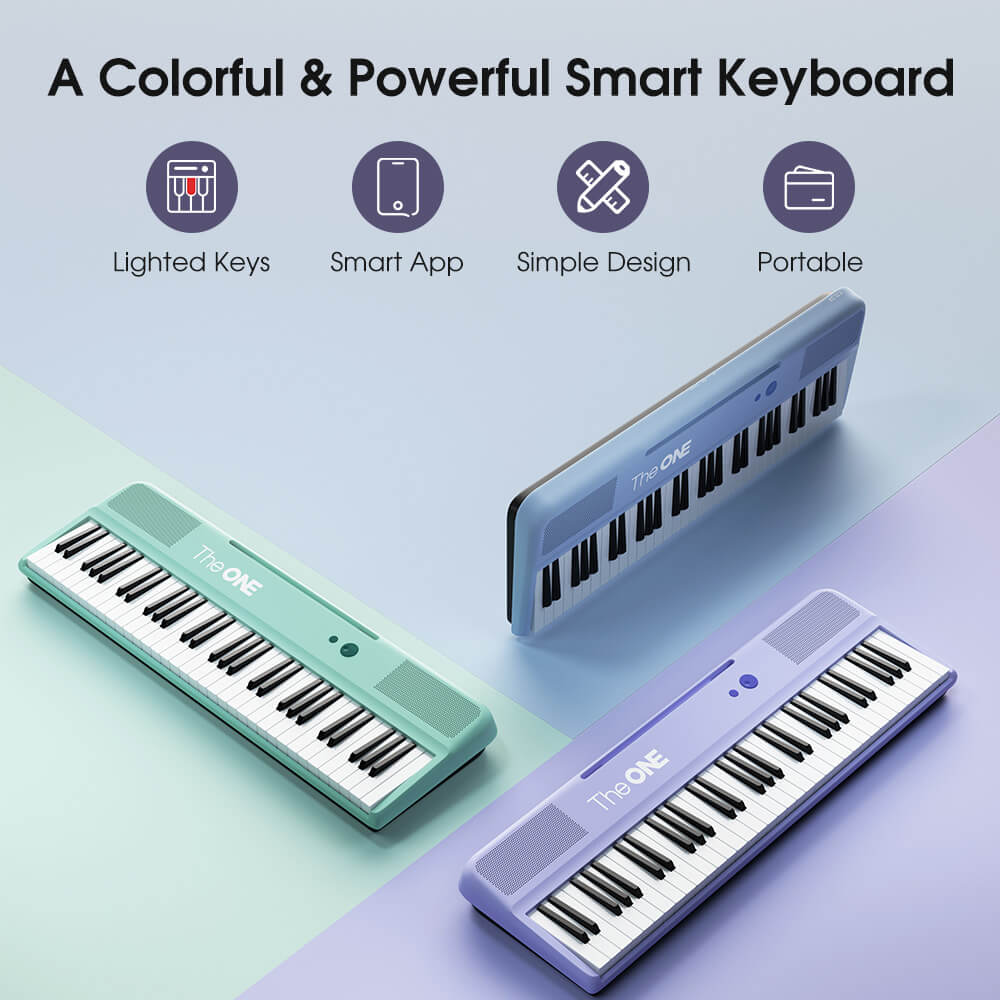
The TheONE COLOR is the clearest example: 61 full-size keys at 7.7 lb, with the option of AA batteries or a DC 5V cord. The Sing Pro takes the other approach, an 88-key weighted instrument that is portable in shape rather than light, because the mechanism inside it has mass. Both are portable, and they are portable in different directions.
The practical test is to imagine the realistic worst case. If you travel by car and play in a different room each week, light plus battery wins. If you perform and need weighted keys on a stand that fits in the boot, the Sing Pro is the only option, and the extra weight is the price of the action. The trade-off between the two is discussed further in best smart piano for beginners.
What should you look for in a portable piano keyboard?
Weight, power, key count and a rigid stand.
Those four decide whether the instrument gets played outside the one room it was bought for. Sound quality follows from the speakers and headphones rather than from the portability itself.
Key count is the specification where portability and repertoire collide. A 61-key keyboard covers beginner method books and most arrangements, and it keeps the instrument light. An 88-key version covers the full range but is heavier by nature, because the extra keys come with a longer frame and, at the top of the range, a weighted mechanism. Decide which side of that line your repertoire sits on before you compare weights, or you will end up optimising the wrong number.
The fourth specification, the stand, is the one people buy last and regret most. A folding stand that flexes under fast passages makes the instrument feel worse than it is, and every portable keyboard needs one that sets up quickly, because the alternative is playing from a table at the wrong height. The options and measurements are in piano stand.
Do portable keyboards sound worse than console pianos?
Smaller, not worse.
A portable keyboard has less cabinet volume and smaller drivers, so it sounds thinner in a room. Through headphones the difference narrows sharply, because the same samples are feeding a pair of drivers sitting on your ears.
That is why the portable category works so well in flats. A learner who practises with headphones hears the full sample set, and the small speakers matter only when someone else is listening. If you do play for other people, the speaker system becomes the specification worth reading: cabinet design and tweeter placement change what a room hears far more than the number of instrument voices does.
Headphone volume deserves a thought at the same time, because a portable instrument invites long sessions at close range. Keep the level where you can still hear a conversation with the headphones on; cumulative exposure over a session is the mechanism behind hearing damage, as the NIDCD describes and the WHO listening-safety programme sets out.
Portable models compared
Three models cover the portable range, from the lightest option to the one with a weighted action. Prices are in US dollars, checked on TheONE's product pages on 28 September 2026.
| TheONE COLOR | TheONE SING | TheONE Sing Pro | |
|---|---|---|---|
| Keys | 61, lit | 61, lit | 88, lit |
| Key action | Touch response | Touch response | Weighted |
| Weight | 7.7 lb (about 3.5 kg) | Portable 61-key frame | Portable 88-key frame |
| Power | AA batteries or DC 5V cord | Mains power | Mains power |
| Extra feature | Colour variants | Singing and auto accompaniment | Red and blue light guidance for each hand |
| Price from (US$) | $325 | $549 | $1,119 |
Choose between the first two columns if weight is the constraint, and move to the third if a weighted action is non-negotiable and the piano still has to travel. The SING adds singing and accompaniment for the same portable footprint; the COLOR is the lightest and cheapest way into the category.
Making a portable keyboard live like a home piano
The trick is a stand that stays up. A portable instrument on a permanent stand behaves like furniture: it is ready when you walk past, and a fifteen-minute session fits into the gap before dinner. A portable instrument that lives in a bag gets played in bursts and then forgotten.
Pick the stand by model, not by price, because they are not interchangeable. The TheONE single-X stand fits the 61-key COLOR only, while the double-X stand fits both the 61-key and 88-key models, folds flat and weighs 6.3 lb. Both cost $119. A bench is the second purchase worth making early, since playing from the wrong height is what makes hands tense, and a pair of headphones at $119 is the third if the household shares its evenings.
Two smaller details are worth checking when the piano arrives. The portable TheONE models include three months of the learning app, so plan the first weeks around that rather than assuming the guidance continues. And the connection runs over Bluetooth on iOS 15.6 and Android 7.0 and above, with a cabled USB option for Android devices that support USB host, so a keyboard that travels never needs to travel with a cable. The keyboard sends each note as MIDI performance data over Bluetooth, with a cabled USB option on Android devices that support USB host. The connection details and what the app does with the data are covered in digital piano with app.
FAQ
What should you look for in a portable piano keyboard?
Four things: weight you can actually carry, battery life that covers a session, key count that matches your repertoire, and a stand rigid enough to play on. The TheONE COLOR weighs 7.7 lb and runs on AA batteries; the Sing Pro is an 88-key weighted portable model.
Do portable keyboards sound worse than console pianos?
They sound smaller, because the cabinet and speaker system are smaller. With headphones the difference narrows sharply, which is why a portable keyboard used with headphones can stand in for a home piano in a flat, and why the speaker system is worth checking if you play for other people.
Can you use a portable keyboard as a home piano?
Yes, on a stand that stays up. The TheONE double-X stand fits both the 61-key and 88-key models, folds flat when needed, and costs $119. A portable keyboard that has a permanent stand gets played like a home piano; one that has to be unpacked does not.
Next step
Write down the two trips you would realistically take the keyboard on, then pick the model that survives both. If there are no trips, buy the stand anyway and treat the portable as a home piano — it is the same instrument, in a room where it fits.
Shipping and returns in short. TheONE ships free within the 48 contiguous United States, with orders usually processed in 1–3 business days and delivery estimated at 3–7 business days after dispatch. International delivery is estimated at 5–15 business days, with shipping and applicable taxes included in the price shown at checkout. Returns within the United States can be requested within 30 calendar days of receipt and require approval.
See the portable models with their weights and power options listed side by side.
If the piano has to fit a small room, digital piano for a small apartment covers placement and volume. If the budget is set, best digital piano under $500 shows what fits under it.


