
The doubt arrives around the third week, usually at the moment a beginner realises they can play the song with the lights and cannot play it without them. At that point the question stops being about the feature and becomes about whether the last three weeks were practice or a demo.
The honest answer is that guided keys help considerably with two specific problems, do nothing for three others, and become a liability only when nobody ever turns them off. Understanding which is which tells you how to use them, and when to stop.
The instruments referenced here are TheONE products, with prices taken from TheONE's product pages on 28 September 2026. This is not an independent test.
What guided keys genuinely improve
Two things, and they happen to be the two that cause the most beginners to quit. The first is note location: a beginner who cannot yet read music spends most of a session working out which key comes next rather than playing. The second is pulse: the delay while hunting for a note breaks the rhythm, and a phrase played out of time cannot be learned as music.
Removing both at once changes what a practice session produces. Instead of four bars played haltingly, you get four bars played in time with a few wrong notes, and wrong notes are far easier to fix than an unstable tempo. That is the whole argument for the feature, and it is a strong one for the first month.
There is a second-order benefit that is easy to overlook: the lights make practice possible without a plan. A learner who does not know what to do next will not sit down; a learner with a guided session waiting will. For an adult squeezing fifteen minutes between work and dinner, that difference decides whether the habit forms at all. The same reasoning sits behind the routine in piano that teaches you how to play. The data behind the guidance is note information rather than audio, transmitted as MIDI performance data over Bluetooth on iOS 15.6 and Android 7.0 and above, which is why the feedback points at a specific bar instead of judging the whole piece.
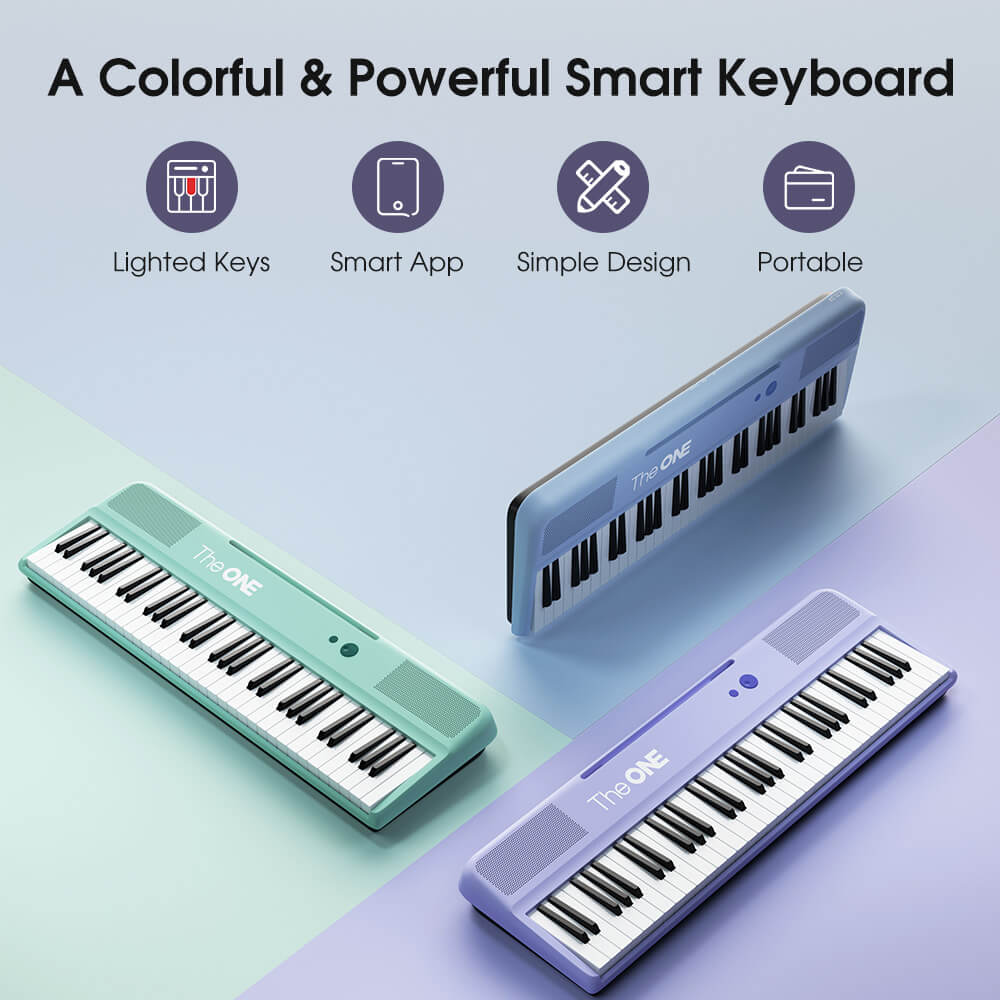
Do light up keys actually help you learn piano?
Yes, for note finding and timing.
They remove the two delays that make early practice feel unproductive. What they cannot do is hear your tone, shape your phrasing or notice that your wrist is locked, so they cover part of a teacher's job rather than all of it.
The evidence is in what learners can do afterwards. Someone who spends three months with the lights on and never plays without them ends up able to perform the songs in the library and little else. Someone who alternates — lights for new material, no lights for revision — ends up able to play those songs from memory, which is a different and much more useful skill.
There is also a reading question. The lights show a position on the keyboard, while music notation shows a position on a stave. They are separate skills, and guided playing does not build the second one. That is why the practice schedule below matters: the lights get you to a playable standard quickly, and reading has to be built alongside them or afterwards. The same tension appears when you compare lights with printed labels, which is covered in piano key stickers.
Will you become dependent on the lights?
Only if you never play without them.
Dependence is a practice habit, not a property of the instrument. The fix takes two minutes per piece and works from the first week rather than after the problem has formed.
The habit is this: every piece you learn with the lights gets played once without them before you move on. If it falls apart, the piece is not learned yet, whatever the app's screen says. If it holds, you have converted a followed piece into a known one, and that is the step most learners skip.
Two supporting habits help. Keep one piece in the week that the app does not contain, so your reading never falls too far behind your fingers. And record yourself once a week, because the app reports notes and timing while a recording reveals the two things it cannot: whether the phrase was even, and whether you were pressing rather than playing. Keep headphone volume at a level where you can still hear a conversation; cumulative exposure is the mechanism behind hearing damage, as the NIDCD explains and the WHO listening-safety programme sets out, and daily practice is exactly that.
Light up keys compared with the alternatives
The table compares the three ways a beginner can be told which note to play, since the trade-offs are rarely laid out side by side. Costs are in US dollars, checked on 28 September 2026.
| Light up keys | Key stickers | Sheet music | |
|---|---|---|---|
| What it shows | The next key, in time | The name of each note | Pitch and rhythm together |
| Carries the tempo | Yes | No | Yes, once you can read |
| Can be switched off | Yes, in the app | Only by peeling them off | Not applicable |
| Cost | Part of the instrument, from $325 | $59 | Free |
| Builds reading | No, on its own | Partly | Yes |
Read it by asking what you are missing. If you cannot yet find a note, stickers name it. If you can find notes but lose the rhythm, lights are the better tool because they carry time as well as pitch. If you can already do both slowly, neither adds much and the money belongs in graded music instead.

How to use guided keys without losing ground
The approach that works is deliberately narrow. Use the lights for the first time you meet a piece, and for the one passage that keeps failing. Everything else — the revision, the warm-up, the piece you are polishing — gets played without them. In practice that means most of a session is unguided after the first month, even though the feature is still installed.
Second, keep a written list of what you can play with the lights off. It becomes the honest record of your progress, and it stops the app's completion percentage from standing in for ability. Third, revisit the lights every so often as a diagnostic rather than a crutch: if a passage you thought was secure collapses at tempo, the lights will show you exactly where the stumble is. Graded material such as the Royal Conservatory of Music levels gives you a sequence to read from that does not depend on the guiding at all.
FAQ
Do light up keys actually help you learn piano?
They help with the two things that stop beginners earliest: finding the right note and keeping a steady pulse. They do not teach dynamics, tone or posture. Used for the first months with the lights switched off for revision, they speed up progress rather than slowing it.
Will you become dependent on the lights?
Only if you never play without them. The habit that prevents dependence takes two minutes: play every piece once with the lights off before moving to the next one. If you can find the notes and keep time without the glow, the guidance has done its job.
Are light up keys better than piano key stickers?
They do different things. Stickers name the note so you can find it yourself; lights tell you the next note in time, and can be turned off in the app rather than peeled off. Stickers suit a keyboard you already own; lights suit a new purchase.
Next step
If you are buying an instrument, treat the lights as a feature you will use for two months and the key action as the thing you will live with for years. If you already own a light-up keyboard, add the two-minute rule this week: one unguided play-through per piece before you move on.
Shipping and returns in short. TheONE ships free within the 48 contiguous United States, with orders usually processed in 1–3 business days and delivery estimated at 3–7 business days after dispatch. International delivery is estimated at 5–15 business days, with shipping and applicable taxes included in the price shown at checkout. Returns within the United States can be requested within 30 calendar days of receipt and require approval.
Compare the guided instruments, from the portable 61-key keyboard to the weighted home pianos.
For how the guidance loop is built, see piano that teaches you how to play. For a first instrument decision, start with digital piano for beginners.


