
These two models sit at opposite ends of the beginner range, and the choice between them is not about quality. It is about whether the piano has to move, and whether your hands are ready for weighted keys.
This comparison covers what actually differs between the 61-key COLOR and the 88-key PLAY, what each one is good at, and the two questions that decide it.
Both models are TheONE products; current specifications and pricing are shown on each product page.
The ONE COLOR vs the ONE PLAY: the two models side by side
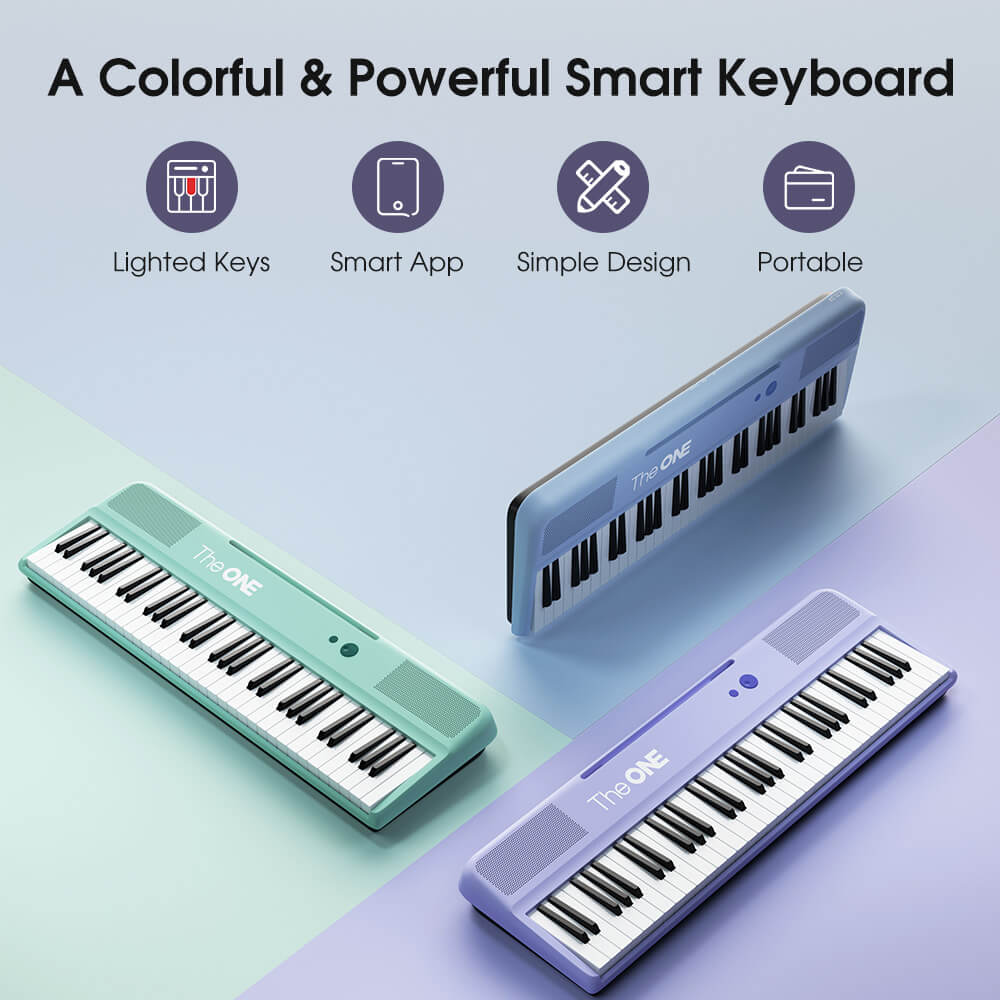
The COLOR is a 61-key portable keyboard with touch response, 64-note polyphony and 256 timbres through the app. It weighs 7.7 lb, runs on AA batteries or a DC 5V cord, and lights every key.
The PLAY is an 88-key piano with a graded hammer action, where the lower keys feel heavier than the upper ones. It measures 54 by 18 by 33 inches, weighs 107 lb, uses mains power, and carries four speakers including two 20W tweeters.
Everything that separates them follows from those two descriptions: one is designed to be carried, the other is designed to stay where it is and be played like a piano.
Which one is better for a beginner?
The COLOR if it has to move; the PLAY if it stays.
The COLOR is the easier start because it is light, battery powered and inexpensive, while the PLAY suits a beginner who wants weighted keys from day one.

That is the whole decision in most households. A portable instrument that gets played daily teaches more than a heavier one that stays in a cupboard, and a weighted instrument that lives where you practise teaches more than either.
The reason this matters more than any specification is that the first year depends on frequency rather than on equipment quality. A 61-key keyboard on a stand in the living room will be played in the gaps of a normal day; a 107 lb piano with nowhere to live will be played when someone decides to make time for it, which happens less often.
The counter-argument is technique, and it is genuine. A light action teaches notes, rhythm and coordination, but it never asks your hand to carry weight. If the goal is classical repertoire or graded exams, the COLOR is a first instrument rather than a final one, and the reasoning is in weighted vs touch sensitive keys.
What changes when you move to weighted keys?
The instrument starts pushing back.
Everything about touch: you use the arm rather than the fingers alone, dynamics respond to how you play, and passages that were easy become tiring before they become controlled.
A graded hammer action adds resistance, and it varies that resistance across the keyboard, so the bottom octaves feel heavier than the top.
Three things change in practice. Your hand learns to support itself rather than press, which is the skill that transfers to any acoustic piano. Dynamics become easier to control, because the key gives you feedback about how much force you are using. And fast passages become harder at first, because there is now something to move.
What does not change is the guidance. Both models light their keys and pair with the same app over Bluetooth on iOS 15.6 and Android 7.0 and above, with a cabled USB option on Android devices that support USB host. The difference in what you get from the app is only the included period: three months on the COLOR, six on the PLAY.

Sound and speakers
This is the difference you notice when somebody else is listening. The COLOR has built-in speakers sized for a desk or a bedroom, which is entirely adequate for practice and for headphones.
The PLAY is built to fill a room: four speakers including two 20W tweeters, with 16-bit stereo samples at a 32 kHz sampling rate. In a shared living room that changes how the instrument feels to play for other people, which matters more than the specification suggests.
Both play through headphones, and both can be used as a controller for software, since the notes travel as MIDI performance data rather than audio. If you practise mainly at night, the two sound closer together than the specification implies; if you play for an audience of family, they do not.
Room size is the variable most buyers underestimate, and it decides which model sounds better in practice rather than on paper. A portable instrument with smaller speakers fills a bedroom easily and starts to sound thin in a large living room, where a console cabinet with four speakers keeps its body at low volume. If your piano will live in a bedroom or a study, the COLOR has more than enough output, and the difference you hear will come from the app and the headphones. If it will sit in a shared living room, the PLAY is the one that will not need to be turned up to be heard.
Portability and placement
The COLOR weighs 7.7 lb and can run on AA batteries, so it can be played on a desk, a bed or a kitchen table and stored in a cupboard. The double-X stand fits both models and folds flat, which turns a portable keyboard into something that stays set up.
The PLAY weighs 107 lb and needs a permanent position with roughly a metre of clear depth behind the keys. In a small flat that is the binding constraint, and it is the reason some buyers choose the portable model despite preferring the weighted action. The placement side of that is covered in piano for a small living room.
There is a third option worth knowing about, because it solves the problem both of these models create. A portable instrument on a wooden stand looks settled in a room without the weight of a cabinet, and it can still be lifted onto a table or carried to a friend's house. If your hesitation is that the COLOR looks temporary and the PLAY is too heavy and too expensive, the answer is usually a portable 88-key model on a proper stand rather than either of these two. The trade is the cabinet and the speakers, which matters less than most buyers expect.
Which should you buy?
Answer two questions.
Buy the COLOR if the piano has to be portable or the commitment is uncertain, and the PLAY if it can stay in one room and you intend to build real technique.
Does the piano have to move or pack away? And do you intend to play graded or classical repertoire?
If the first answer is yes and the second is no, buy the COLOR. It covers beginner method books and most pop and film arrangements for a few years, and it stays useful afterwards as a travel keyboard. If the first answer is no and the second is yes, buy the PLAY and skip the intermediate step.
The middle case — a piano that has to move and a player heading for graded material — is where the 88-key weighted portable models fit, and that comparison is set out in best smart piano for beginners. Whichever you choose, set the seat height before you judge the keys, since an instrument at the wrong height feels wrong in ways the specification cannot explain. Keep headphone levels comfortable too, the practical form of the guidance from the NIDCD and the WHO listening-safety programme.
One factor deserves more weight than the specification tables give it, and that is who else will play the instrument. A lighter action is easier for a child, a beginner and anyone whose hands fatigue quickly, while a weighted action suits an adult who intends to build technique and may later play an acoustic piano. If two people in the same household are learning, the PLAY is usually the better single purchase because it satisfies both requirements at once. If the piano is for one person who is still deciding how seriously they want to take it, the COLOR leaves more money in the budget for lessons.
FAQ
Is the COLOR or the PLAY better for a beginner?
The COLOR is the better first instrument for most beginners, because it is light enough to keep wherever the family actually is, it can run on batteries, and it costs far less to find out whether piano sticks. The PLAY is the better instrument for a beginner who already knows they want to play properly, because 88 weighted keys with graded hammer action build the technique that transfers to an acoustic piano later. Choosing the COLOR is not a compromise on learning, only on touch.
Do I need 88 keys to start learning piano?
No. Beginner method books, most pop songs and nearly all children's material stay inside the five octaves that 61 keys cover, so the notes above and below that range go unvisited in the first year. The limitation appears later, when a specific piece uses the bottom or top octave, and at that point the question becomes whether the instrument is worth replacing rather than whether it was the wrong choice. Key size matters more than key count for a beginner: both models use full-size keys.
Can the COLOR be used as a main piano?
It can, and plenty of adults use one that way for the first year or two, provided they are honest about the trade. The COLOR has full-size keys and 61 of them, so it teaches hand spacing correctly, but its action is lighter than a console piano's and its speakers are smaller. If your goal is playing songs and reading music, that is enough. If your goal is graded material and dynamics, the lighter action becomes the limiting factor before the key count does.
Next step
Measure the space, then answer the two questions above. If portability and key action point to different models, choose portability first: an instrument that is played daily teaches more than the one with better specifications sitting in a case.
Shipping and returns in short. TheONE ships free within the 48 contiguous United States, with orders usually processed in 1–3 business days and delivery estimated at 3–7 business days after dispatch. International delivery is estimated at 5–15 business days, with shipping and applicable taxes included in the price shown at checkout. Returns within the United States can be requested within 30 calendar days of receipt and require approval.
Compare the two models directly, with keys, key action and speaker system listed side by side.
If the budget is set lower, the models at the entry end of the range are worth comparing before you commit.


