
The word covers a keyboard on a desk and a cabinet instrument that costs as much as a small car, and both are called digital pianos. The label describes how the sound is made, not how good the instrument is.
This guide explains what a digital piano actually does, where it sits between an acoustic piano and a keyboard, and which specifications decide whether one is worth buying.
The models referenced are TheONE products; current specifications and pricing are shown on each product page.
How a digital piano makes sound
It plays recordings. Makers record a grand piano note by note at several volumes, store those samples, and play the matching recording when you press a key. The speakers or headphones then reproduce it.

Everything else follows from that. Because the sound is stored data, a digital piano never needs tuning, can be played through headphones, and can be made portable. It also means the instrument depends on electronics rather than on strings and a soundboard, which is where the honest trade-offs begin.
The keys, though, are mechanical. A weighted key uses a mechanism that resists your finger, and a graded hammer action makes the lower keys heavier than the higher ones, imitating the way hammers and strings behave inside an acoustic piano. That mechanism is the most expensive part of a digital piano, and it is the part that decides whether the instrument feels like a piano or like a keyboard.
Is a digital piano a real piano?
It is a real instrument, but it is not an acoustic piano.
It is a real instrument and a real piano in every sense that matters for playing, but the sound is generated electronically instead of by strings and hammers.
The notes, the keyboard layout and the technique transfer directly. What differs is the source of the sound, the maintenance, and the resale value, and none of those decide whether a beginner can learn on one.
The practical differences are worth knowing. An acoustic piano needs regular tuning and reacts to humidity; a digital piano needs neither, which removes a recurring cost and a reason for the instrument to sound wrong. An acoustic piano holds its value better; a digital instrument dates as electronics do. And an acoustic piano cannot be played quietly, which in a flat is often the difference between practising and not.
What transfers is the physical skill, provided the digital instrument has weight in the keys. That is the whole argument for comparing key action before anything else: a light keyboard teaches notes and rhythm, while a weighted action teaches the hand to carry weight, and the second is what an acoustic piano expects from you. The comparison in full is in smart piano vs traditional piano.
What makes a digital piano smart?
Two pieces of hardware and one service.
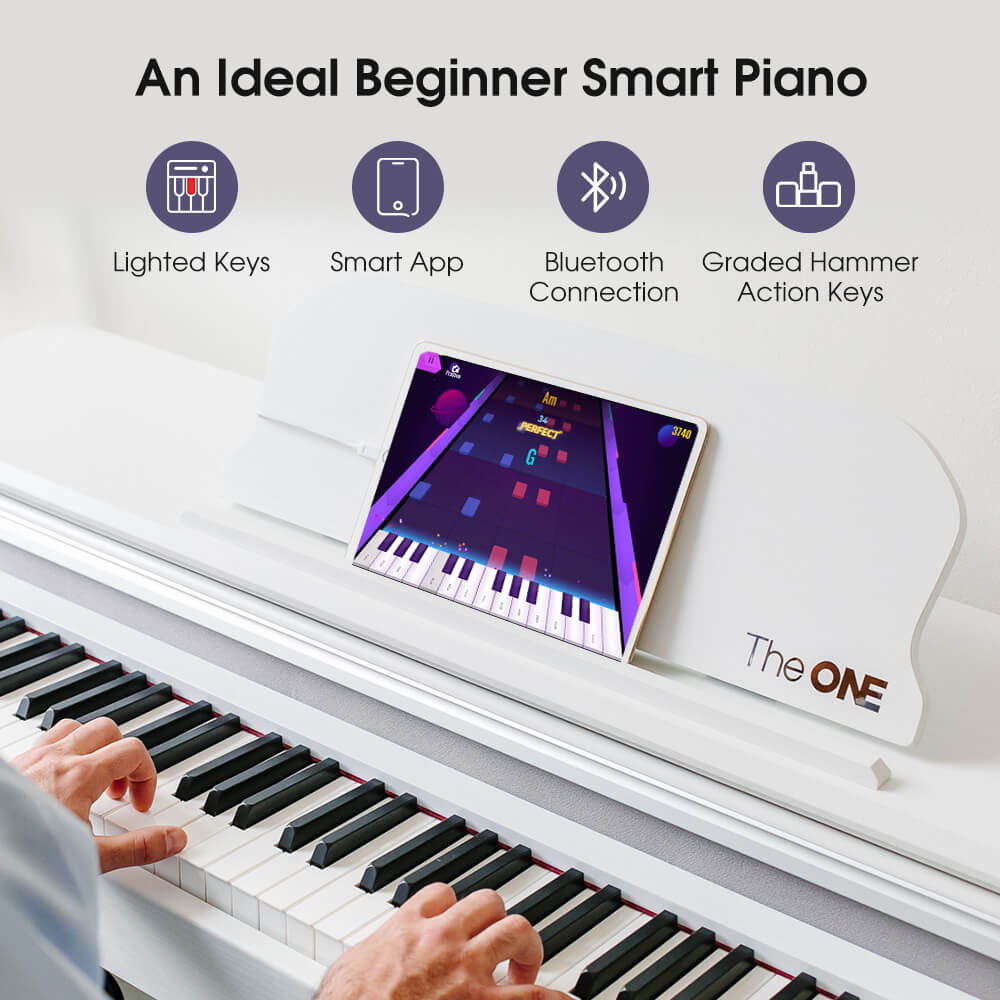
A smart piano reports every key press to an app, so the software can light the next key, scroll the score and flag a wrong note as you play.
Individually lit keys, so the instrument can show the next note without a screen. Sensors that report what you played as performance data, described by the MIDI standard, so software can mark your mistakes. And a companion app that turns those two into lessons and feedback.
That combination is what the word smart has come to mean, and it is why a smart piano is still a digital piano underneath. Switch the app off and you are holding an ordinary digital instrument with the same key action, speakers and connection options as any other.
The connection is the part that ties it together. TheONE keyboards pair over Bluetooth on iOS 15.6 and Android 7.0 and above, with a cabled USB option on Android devices that support USB host, so the guidance keeps working whether or not wireless behaves.
The specifications that matter
Four, in this order. Key action, because it cannot be added later. Key count, because it decides what repertoire is reachable. The speaker system, because that is what anyone else hears. And the connection options, because that decides whether the guided software works.
Everything below those four is preference. Polyphony needs to be sufficient for what you play and no more. The number of instrument voices is almost irrelevant to a beginner. Cabinet finish matters when the piano lives in a shared room and not otherwise.
Two habits are worth pairing with the instrument from the start. Keep headphone levels low enough to hear a conversation, the practical form of the guidance in the NIDCD material on hearing loss and the WHO listening-safety programme. And keep some material that is sequenced by difficulty, such as the Royal Conservatory of Music levels, so progress does not depend on what a library happens to contain.
What a digital piano cannot do
It cannot produce sound without power, and it cannot be repaired as simply as an acoustic instrument when electronics fail. Those are the two practical limits, and neither affects a beginner.
It also cannot give you the acoustic experience of sound coming from a soundboard rather than a speaker. That difference is real and it is why some players eventually keep both instruments. For the first years of learning it rarely matters, because the bottleneck at that stage is coordination and reading rather than tone.
FAQ
Is a digital piano the same as a keyboard?
No, and the difference is in the keys rather than the electronics. A digital piano aims to reproduce the touch of an acoustic instrument, which means weighted or hammer-action keys, full key size and a sustain pedal, so it is played with the same technique. A keyboard usually has lighter, sprung keys and is built for portability and sound variety instead. Many keyboards also run on batteries and include hundreds of accompaniment styles, which a digital piano generally does not.
Do digital pianos need tuning?
No. There are no strings to stretch and no hammers to regulate, so a digital piano stays in tune for its working life and never needs a technician visit for pitch. What does need attention over the years is the key action, which can become noisy or uneven on an instrument that has been played hard, and the electronics, which eventually reach the end of their supported life. Tuning is the maintenance cost a digital piano removes; contact cleaning and key replacement are the ones it can still incur.
How long does a digital piano last?
A well-kept instrument commonly lasts ten to fifteen years and often longer, and the parts that age first are the key contacts, the pedal and the power supply rather than the sound engine. Whether it lasts that long depends largely on support rather than on build quality: an instrument still covered by current spare parts can be repaired cheaply, while a discontinued model may be unfixable even when it looks immaculate. Buying a current model is therefore a longevity decision as much as a specification decision.
Next step
Decide in this order: the key action you want, how many keys you need, and where the piano will live. Those three answers narrow the range to one or two models, and the specification list stops being a distraction.
Shipping and returns in short. TheONE ships free within the 48 contiguous United States, with orders usually processed in 1–3 business days and delivery estimated at 3–7 business days after dispatch. International delivery is estimated at 5–15 business days, with shipping and applicable taxes included in the price shown at checkout. Returns within the United States can be requested within 30 calendar days of receipt and require approval.
See the digital pianos in the range, with key action and keys listed for each model.
If you are buying your first instrument, digital piano for beginners covers the decision in detail, and weighted vs touch sensitive keys explains the specification that matters most.
Explore more on this topic: Visit our Digital Piano Design Formats and Smart Features Guide.