
Weighted keys are usually the better long-term choice when a beginner wants traditional piano technique and expects to play acoustic pianos. Semi-weighted keys can be the better practical choice when portability, synthesizer playing, a lighter touch or limited space determines whether the instrument gets used. The label alone is not enough: actions vary, so compare control, repetition and comfort on the actual instrument.
Quick decision
- Choose weighted or hammer action for piano-centered study and acoustic-piano transfer.
- Consider semi-weighted action for portable keyboard work, mixed sounds and frequent transport.
- Do not confuse touch sensitivity with physical key resistance.
- Test soft notes, repeated notes, chords and register changes before buying.
- A playable instrument used daily is more valuable than a theoretically ideal one that is impractical at home.
What do the two actions feel like?
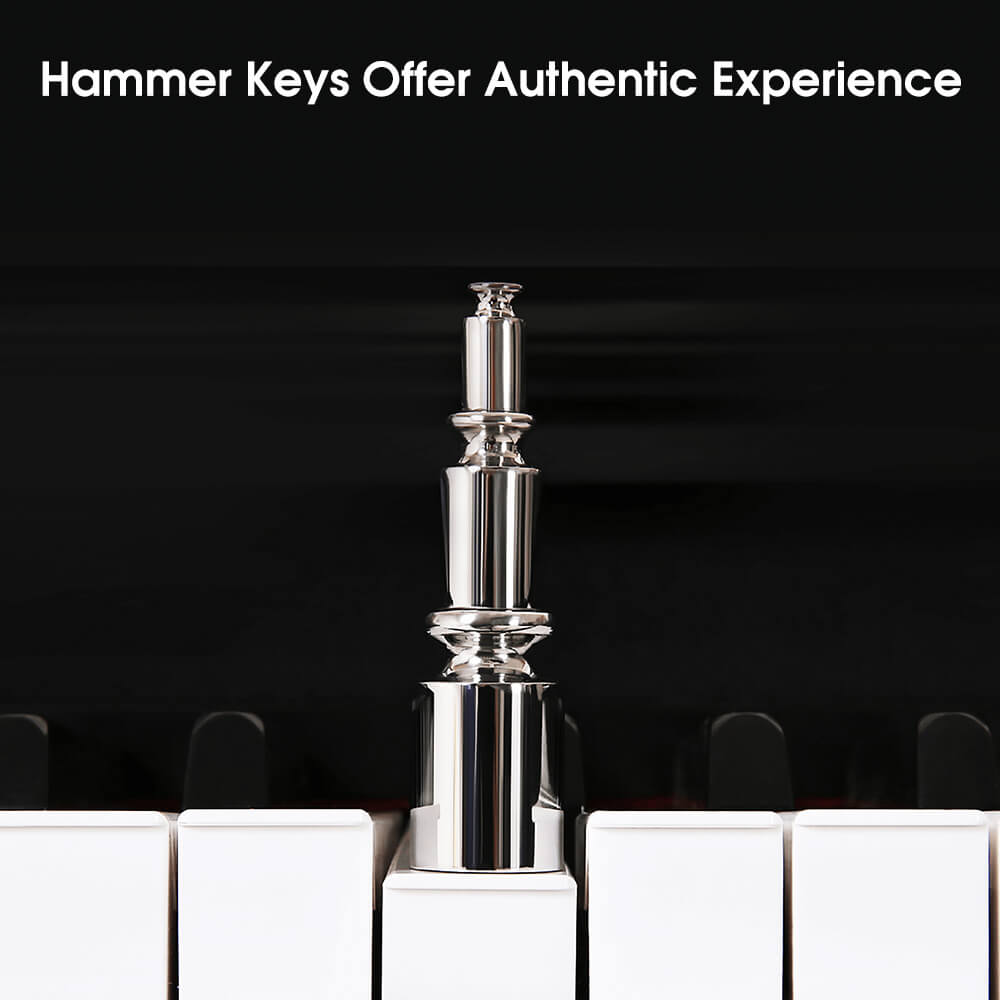
A weighted or hammer-style action adds resistance intended to move more like a piano key. Semi-weighted action generally combines a spring-based return with added resistance, producing a lighter and often faster feel. Neither term is a standardized score for quality, heaviness or realism across every manufacturer.
How does the choice change daily practice?
| Practice task | Weighted action | Semi-weighted action |
|---|---|---|
| Soft-to-loud piano control | Often offers a more piano-like resistance to work against | Can respond dynamically, but the physical feel transfers differently |
| Repeated synth/organ-style notes | May feel slower or heavier | Often feels quicker for this playing style |
| Acoustic-piano transfer | Usually closer in resistance and return | Requires more adjustment |
| Moving the instrument | Hammer mechanisms often add weight | Often easier to carry, depending on the model |
Which beginners benefit most from weighted keys?
Prioritize them if lessons, exams or repertoire center on piano; if the learner regularly uses an acoustic instrument elsewhere; or if control of dynamics and pedaling is the long-term goal. Weighted action does not automatically make technique correct, and an excessively heavy or uneven action is not better merely because it feels difficult.
When can semi-weighted keys be the sensible choice?
They can suit a learner focused on chords, songwriting, production or multiple keyboard sounds, especially when the instrument must travel or be stored after every session. A young or cautious beginner may also prefer a lighter start. Reassess later if the repertoire or teacher requires an acoustic-like action.
Consider the learner and the practice room together
An adult preparing classical repertoire, a child taking weekly acoustic-piano lessons and a songwriter carrying a keyboard to rehearsals are not solving the same problem. Ask where the learner will play outside the home, how often the instrument must move and whether the expected music uses sustained piano control or quick organ/synth gestures.
For a child, check bench height and reach before blaming the key action for difficulty. For any learner, persistent pain is not a normal sign that “stronger fingers” are developing. Stop, review posture and technique with a qualified teacher, and make sure the action is functioning normally.
Run this five-minute playing test
- Play five adjacent notes as quietly and evenly as possible.
- Repeat one note slowly, then faster, and notice whether it returns reliably.
- Play a three-note chord at soft, medium and strong levels.
- Compare a bass scale with a treble scale.
- Play a short passage you already know and notice tension, control and mistakes.
- Check whether the complete instrument can stay set up where practice happens.
Plan for a later transition
If a semi-weighted keyboard is the realistic starting point, it does not make the purchase a failure. Arrange occasional practice on the action used in lessons, keep repertoire within the instrument’s range and review the decision when dynamics, pedaling or acoustic transfer becomes a bottleneck. When moving to weighted keys, slow familiar passages and recalibrate quiet attacks, repeated notes and chord balance instead of expecting the same finger effort.
Look beyond the action label before buying
Key action is only one part of the practice experience. Check the key count, pedal support, stand stability, bench height, headphone use and whether the controls are simple enough for daily practice. A weighted action on an unstable X-stand can still encourage inconsistent posture; a semi-weighted keyboard left permanently ready may support more practice than a heavier instrument that must be unpacked each time.
Compare the actual models at the volume and touch settings you would use at home. Loud demo speakers can make an action feel more expressive than it is, while an unfamiliar heavy touch can initially seem “professional” simply because it is difficult. The useful question is whether the learner can control the instrument from quiet to strong playing without bracing the wrists or losing note accuracy.
What should you ask the teacher?
Bring the course level, current repertoire and likely exam or performance plans into the decision. Ask whether the learner needs regular access to an acoustic-style action now, whether occasional access elsewhere is enough, and what signs would trigger an upgrade. A specific answer tied to the next year of study is more useful than a universal rule about what every beginner should buy.
Frequently asked questions
Are semi-weighted keys bad for beginners?
No. They serve different goals and constraints, though piano-focused learners may later need more adaptation.
Are all weighted actions equally realistic?
No. Mechanism, grading, pivot, sensors and overall design affect the result.
Should a beginner choose the heaviest action?
No. Choose controllable, even resistance that fits the learner and intended repertoire.


