If you are choosing a first keyboard, digital piano vs synthesizer is the comparison that usually matters, and an arranger or a bare MIDI controller can confuse the choice even more. The instruments can look similar in a product photo, but they are built for different jobs: piano practice, sound design, or auto-accompaniment. This guide explains which one you actually need. When it recommends a learning instrument, it covers only current The ONE Music models, not an independent lab test of other brands' synthesizers.
Digital piano vs synthesizer vs arranger: which one do you actually need?
Choose a digital piano to learn or practice piano with a piano-like feel and built-in speakers. Choose a synthesizer to design electronic sounds, not to build piano technique. Choose an arranger for auto-accompaniment under your melody. This store sells smart pianos and keyboards, not a dedicated synthesizer or arranger line.
If your goal is piano lessons, songs, or traditional practice, start with a digital or smart piano. If your goal is inventing textures, leads, and basses, you want a synthesizer, and you should not expect a piano-practice action to be the point of that instrument. If you want backing styles to run under a right-hand melody, you are looking at the arranger category.
Those three jobs overlap in marketing photos more than they overlap in use. This page stays on that choice. For the narrower difference between a smart piano and a digital piano, see the existing smart piano vs digital piano guide rather than repeating it here.

Decision table: feel, sound source, key action, speakers, and learning features
The useful differences are feel, sound source, key action, speakers, and learning features, not which instrument looks more like a piano in a photo. A digital or smart piano is built so you can practice piano. A synthesizer is built so you can design and perform electronic sounds. An arranger leans on auto-accompaniment, and a MIDI keyboard with no speakers is only a controller until another device makes sound.
| Digital or smart piano | Synthesizer | Arranger or workstation | MIDI keyboard, no speakers | |
|---|---|---|---|---|
| Feel | Built for sitting down and playing piano, including home furniture-style models | Built for performing and shaping electronic sounds, not for piano recitals | Built for playing a melody over automatic backing | Varies; you feel the keys, but you hear another device |
| Sound source | A piano-focused sound engine, plus additional tones that vary by model | A sound you design or perform, from a generated or sampled tone | Auto-accompaniment styles plus instrument tones | None on its own; it sends MIDI messages |
| Key action | Current The ONE 88-key smart pianos have full weighted keys; 61-key models are portable full-size keyboards (SING adds touch-responsive keys versus COLOR, per official Early Black Friday copy) | Often a lighter synth-action; a graded-hammer piano action is not the point of the category | Often lighter than a home digital piano; check that maker's own specifications | Varies widely by controller |
| Speakers | Built-in on current The ONE home pianos, SING, and SING Pro; COLOR lists a headphone socket and a piano timbre after power on | Varies; many are meant to go through a PA, headphones, or a computer | Often built-in on home arrangers; confirm on that model's official page | Typically none |
| Learning features | Light-up keys and a beginner learning app on current The ONE smart pianos | Sound-design controls, not a piano lesson path | Style and registration features, not the same as a smart-piano lesson path | Depends entirely on the software you connect |
The synthesizer and arranger columns are general category descriptions. They are not specifications or prices for a named third-party model. If you already own another brand's instrument, use that maker's official support to confirm what it is; the Casio US support hub is one starting point.
What is a digital or smart piano built to do?
A digital or smart piano is built for playing and practicing piano, not for designing new electronic sounds. It uses a piano-focused sound engine, and current The ONE 88-key models have full weighted keys. Light-up keys and a learning app can guide practice. It is not a synthesizer workstation or a full arranger.
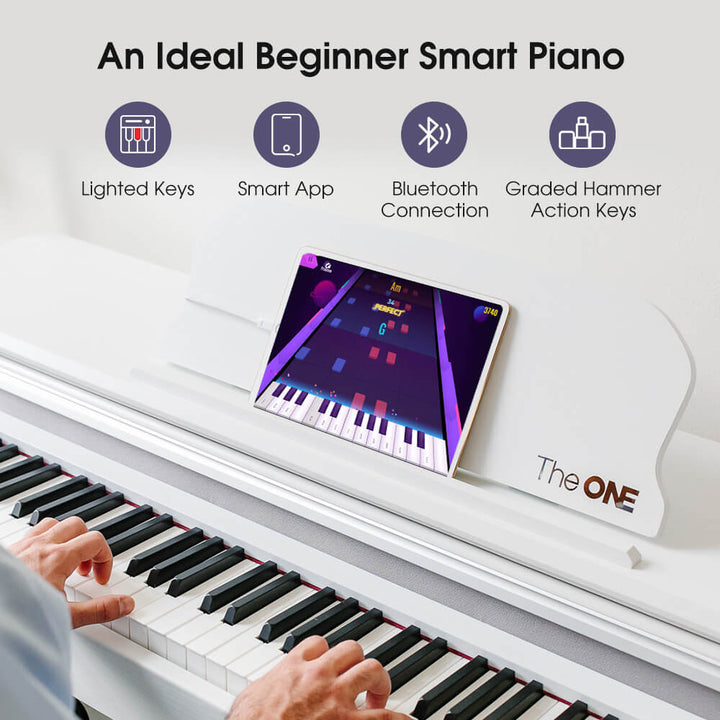
In this catalog, that means a portable 61-key instrument such as COLOR or SING, or an 88-key weighted home or compact model such as SING Pro, PLAY, TOP1X, or TOP2. Official site-wide FAQ wording says all of The ONE 88-key Smart Pianos have full weighted keys. Furniture-style models such as PLAY, TOP1X, and TOP2 include speakers and three pedals. SING Pro has four built-in speakers; its compatible wooden furniture stand with three pedals is sold separately.
A Yamaha USA FAQ, re-checked on 2026-11-10, states that Yamaha digital pianos cannot go out of tune in the string-tuning sense, and that Yamaha instruments are set at A = 440 Hz. That wording is from Yamaha FAQ article 000001370, not from The ONE product pages, and it is cited only as a contrast: a digital piano is a piano first. How The ONE's smart-piano lesson features compare with a plain digital piano is already covered in the smart-piano comparison article, so this page does not retell it.
What is a synthesizer built to do?
A synthesizer is built for sound design and electronic performance, not for piano practice. You start with a generated or sampled tone and shape it, rather than sitting down to a piano action and a piano voice. That is a different job from a digital piano. This store does not sell a dedicated synthesizer line.
People often use "synth" loosely for any keyboard that is not an acoustic piano. That blurs a real distinction. A synthesizer's job is to create and shape electronic sound. A digital piano's job is to feel and sound like a piano when you practice. You can later trigger software instruments from a keyboard that has USB MIDI, but that secondary use does not turn a smart piano into a synthesizer workstation.
This article does not assign a filter type, a key-bed specification, or a price to any third-party synthesizer. Those details are omitted here unless they come from that maker's official page, and they are out of scope for this guide. If sound design is your primary goal, look at the synthesizer category elsewhere rather than forcing a piano-learning instrument to do that job.
Arranger keyboards and workstations: auto-accompaniment vs a piano action
An arranger keyboard is built to play automatic backing styles under your melody, not to replace a piano action. A workstation usually adds production tools on top of that idea. Both are different from a digital piano, even when the cabinet has built-in speakers and a music rest. This store does not currently sell a dedicated arranger or workstation line.
Auto-accompaniment is the key feature: you play a melody or a chord pattern, and the instrument supplies a style, a rhythm, and often a band-like backing. That can be fun for sing-alongs and solo performance, but it is not the same thing as a graded-hammer piano practice instrument. Third-party arranger feature lists vary by model; this page does not invent a competitor's style count, speaker rating, or price.
The ONE SING can sing along with auto accompaniment in TheONE Sing App, which official copy limits to TheONE Sing Smart Piano and TheONE Sing Pro Smart Piano. That is app-guided accompaniment on a smart piano, not a full arranger-workstation category. If you want piano lessons first and a sing-along layer second, SING is still a learning instrument in this catalog, not a substitute for a dedicated arranger.

When is a MIDI keyboard with no speakers the wrong first instrument?
A MIDI keyboard with no speakers is a controller, not a complete first instrument. It sends MIDI messages to a computer, app, or sound module, and it stays silent until that other device makes sound. If you want to sit down and hear piano immediately, choose an instrument that makes its own sound instead.
MIDI is a way for instruments and computers to exchange notes and controls, not a type of piano sound. The MIDI Association's overview of MIDI and the MIDI Association home page are the official primers for that distinction. A bare controller can be a good later purchase once you already have a computer, software, and headphones or monitors. It is a poor first instrument if you expected to open a box and play piano in a living room.
Some complete instruments can also act as controllers. Official COLOR copy says the keyboard is usable as a MIDI controller with a computer, and SING lists a USB MIDI port. That is a useful extra, not a reason to start with a speakerless controller. If you later connect a keyboard to a third-party lesson app, use that app's own MIDI help; Simply Piano's note-recognition and MIDI help is one example. The official Smart Piano app page does not state Simply Piano, Flowkey, or Yousician certification, and this is not an app-compatibility article.
If your goal is learning piano, which current The ONE form factor fits?
If your goal is learning piano, choose a current The ONE 61-key portable or an 88-key weighted smart piano, depending on the music you want to play. Official Early Black Friday FAQ copy, checked 2026-11-10, says 61 keys cover many pop songs, chords, and beginner pieces, and 88 keys suit classical or traditional study.
COLOR and SING are the current 61-key portables with light-up keys. Official Early Black Friday wording says both offer 61 keys and light-guided learning, that COLOR is an affordable way to start exploring piano, and that SING adds touch-responsive keys and works with TheONE Sing App for playing and singing along. SING Pro, PLAY, TOP1X, and TOP2 are the current 88-key weighted options, from a compact sing-along piano to furniture-style home models.
This recommendation covers only The ONE's own current catalog. It is not a ranked test of other brands, and a "best sellers" collection name elsewhere on the site is merchandising, not a verified sales ranking. If you are still choosing between a 61-key keyboard and an 88-key digital piano as a beginner, the existing digital piano vs keyboard guide covers that adjacent choice without repeating it here.

If your goal is production or sound design, what does this store sell?
This store's current catalog is smart pianos, keyboards, electronic drums, accessories, and apps. It does not sell a dedicated synthesizer or arranger-workstation line. If your main goal is sound design or auto-accompaniment styles, you will not find that category here. A smart keyboard with USB MIDI can trigger software, but that is a secondary use.
That is a catalog fact, not a judgment that synthesizers or arrangers are lesser instruments. They are simply not what this store currently merchandises as sellable piano or keyboard bodies. Do not treat older landing-page names as current hero products, and do not expect a future synthesizer line that has not been announced here.
If piano learning is still the main job, stay with a current The ONE form factor above. If production is the main job, you will need a dedicated synthesizer, a workstation, or a computer-based setup sold elsewhere, and you can add a The ONE keyboard later only as a controller or a practice piano. This page will not invent a The ONE synthesizer to close that gap.
FAQ
What are the key differences between a piano and a synthesizer?
A piano, including a digital or smart piano, is built so you can play and practice piano: a piano-like feel, a piano-focused sound, and usually a complete instrument with its own sound. A synthesizer is built so you can design and perform electronic sounds, starting from a generated or sampled tone you shape. Those are different jobs, even when the keyboards look similar. This page recommends only current The ONE Music models when the question is piano learning, and it is not an independent test of other brands' synthesizers. The store does not currently sell a dedicated synthesizer line.
What is a MIDI keyboard?
A MIDI keyboard sends note and control messages to another device, instead of being defined only by its own built-in sound. MIDI is a communications protocol; the MIDI Association's overview is a plain-language starting point. Some MIDI keyboards have no speakers and stay silent until a computer, app, or sound module makes sound, which is why a bare controller is often the wrong first instrument if you want to hear piano immediately. Some complete instruments, including certain The ONE keyboards, can also be used as a MIDI controller with a computer, but that is a secondary use.
What is the difference between analogue and digital synths?
In general terms, analogue synthesizers generate and shape sound with electronic circuits, while digital synthesizers generate sound with digital processing, samples, or modeling. Many modern instruments mix those approaches. This is a category description only; this article does not assign a circuit type, a specification, or a price to any third-party model. The ONE Music does not currently sell a dedicated synthesizer line, analogue or digital, so this page cannot recommend a The ONE synthesizer for sound design.
How does a synthesizer work?
In broad terms, a synthesizer starts with a raw tone and lets you shape pitch, timbre, and loudness, then perform or record the result. That workflow is sound design, not the same thing as sitting down to a piano voice and a piano action. Digital pianos play a piano-focused sound engine. A synthesizer's job is different, and this store's current catalog does not include a dedicated synthesizer or arranger-workstation line. If your goal is piano practice, choose a digital or smart piano instead.
Next step: official product, collection, or comparison pages
If you want to learn piano, choose a current The ONE 61-key portable or an 88-key weighted smart piano based on the music you want to play, then open the product page for that form factor. If you want a dedicated synthesizer or arranger-workstation, this store does not currently sell that line, and this page will not invent one.
Start with the smart piano collection to see the current learning instruments, and use the smart-piano and beginner-keyboard guides linked above if your remaining question is a narrower comparison. There is no need to force one instrument to do every musical job.
When you are ready to compare current learning instruments, browse the smart piano collection and open the model that matches the music you want to play.