
A thousand dollars sounds like a comfortable budget for a first piano, and it lands in an awkward place. Above the portable keyboards and below the weighted instruments, it is the price band where most listings describe features instead of key action, because that is what they have to sell.
The honest version is that $1,000 buys an excellent portable keyboard plus the setup that makes it usable, or the first half of a weighted piano. This guide shows where that line falls on TheONE's range, what each side gives you, and how to decide which mistake is cheaper to make.
Every price below was checked on TheONE's product pages on 28 September 2026. This is not an independent test.
Where $1,000 lands in the range
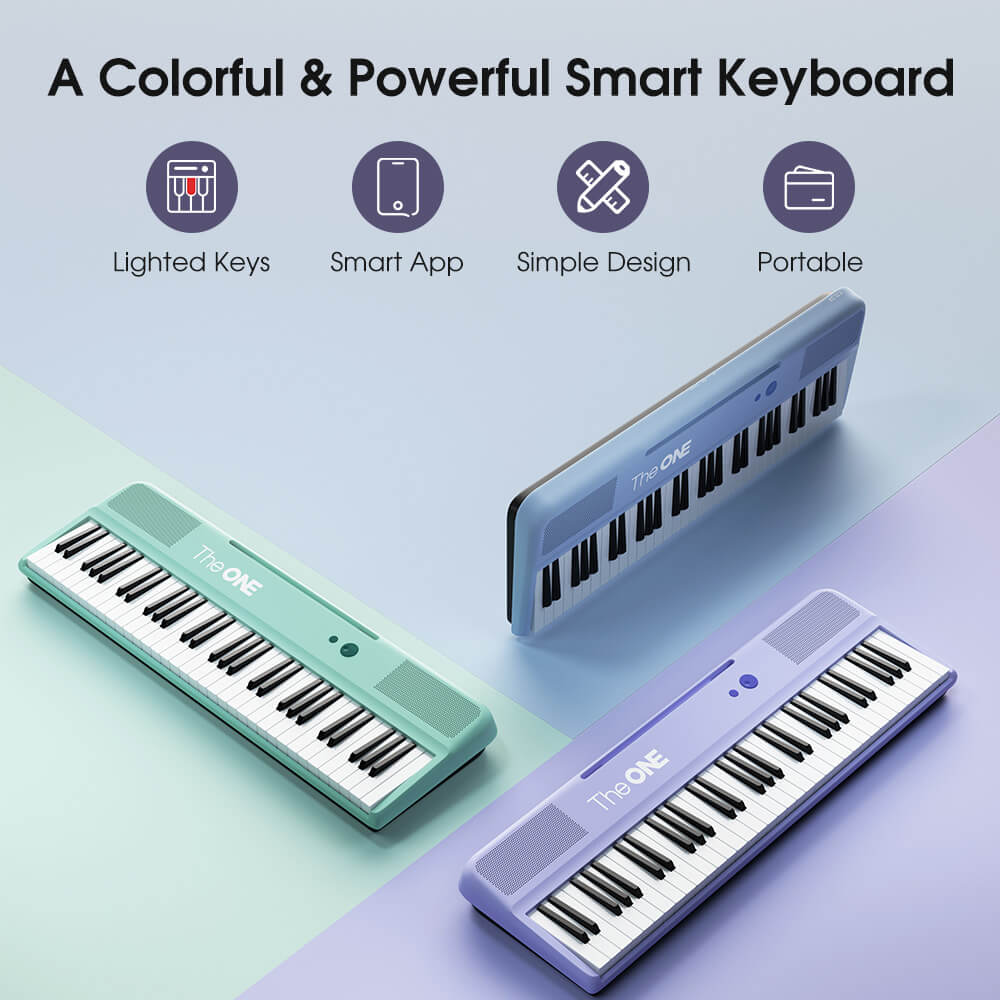
The portable side of the range fits inside this budget comfortably. The 61-key COLOR starts at $325, and its bundles with a stand and bench run to $539. The SING, which adds singing and auto accompaniment, starts at $549. Both are genuine instruments with lit keys, app guidance and full-size keys.
The weighted side begins above it. The 88-key weighted Sing Pro starts at $1,119, the home PLAY at $1,599, and the TOP1X at $1,999. There is no weighted 88-key piano in the TheONE range under $1,000, and that is not an accident of one brand: the mechanism that gives keys their weight costs money, and it is the single most expensive part of a digital piano.
That leaves the budget with a decision rather than a shopping list. Spend it inside the portable category and get a complete setup with change, or put it towards a weighted instrument and accept that the stand, bench and remaining budget arrive later. The rest of this guide is about choosing between those two, and the deeper comparison of the mechanism is in weighted vs touch sensitive keys.
What can you buy for under $1000?
A complete portable setup, or part of a weighted piano.
Inside the budget you can have a 61-key instrument with lit keys, a stand, a bench and headphones, and still be under the figure. What you cannot have is a weighted 88-key piano with everything around it.
The reason this matters is that buyers often compare a fully equipped portable setup against a bare weighted piano and conclude the portable is better value. It is better value in the sense of more objects; it is not better value in the sense of what it teaches. A light action teaches notes, rhythm and coordination, and those are real skills. A weighted action additionally teaches the hand to carry weight, and that is the skill that transfers to every other piano.
The way through is to separate the two questions. What do I want to play, and where will I keep it? If the answer to the first is pop arrangements and accompanying yourself singing, the portable side genuinely covers it for years. If the answer is classical repertoire or graded material, the weighted side is not a luxury but the requirement.
Is it worth stretching the budget?
Yes if the habit is already real; no if it is not.
Stretching to the $1,119 Sing Pro or the $1,599 PLAY makes sense for someone who has been practising on something for months. It rarely makes sense for someone who is buying in order to find out whether they will practise at all.
There is a version of this decision that avoids both mistakes. Buy the portable instrument now, budget the setup properly, and set a review date six months out. If you have practised consistently, sell or keep the portable as a second instrument and move up to weighted keys with the knowledge that the habit is real. That path costs more in total, but it costs the same as one wrong purchase in the other direction.
What it protects you from is the most expensive outcome: a weighted piano bought with ambition rather than habit, sitting in a room while the player feels guilty about it. Instruments that are not played do not improve either the player or the resale value.
The two honest options compared
The table sets out what each side of the budget delivers in practice. Prices are in US dollars, checked on 28 September 2026.
| Stay inside the budget | Stretch to weighted keys | |
|---|---|---|
| What you get now | Keyboard, stand, bench, headphones | Weighted piano, setup bought later |
| Example | COLOR bundle from $539, plus $119 stand and $149 bench | Sing Pro from $1,119 or PLAY from $1,599 |
| Key action | Touch response | Weighted, or graded hammer action |
| What it teaches | Notes, rhythm, coordination, dynamics | All of that, plus finger support and transferable technique |
| Repertoire ceiling | Beginner books, pop, film, accompaniment | Full-range classical and graded repertoire |
Read the table by asking which column describes your next two years rather than your next two months. The portable column is the better answer for most first purchases, and it is not a compromise: it is the correct instrument for learning whether the habit exists, and it stays useful afterwards as a travel keyboard.

What the budget has to include besides the piano
A stand and a bench, in that order. The double-X stand at $119 fits both the 61-key and 88-key TheONE models, which means it survives an upgrade, and the single-X stand at the same price fits the COLOR only. The bench at $149 is the purchase people skip and then regret, because playing from a dining chair puts the keyboard at the wrong height and the hands take the strain.
Headphones at $119 belong in the budget if the household shares its evenings, and they are what makes a late session possible without disturbing anyone. Keep the level low enough to hear a conversation, which is the practical version of the WHO listening-safety programme. Pedal can wait: the standalone sustain pedal fits the TOK, TON, NEX and Sing Pro rather than every model, and most beginners do not need one until the first pieces ask for connected sound.
Two smaller costs are easy to miss. The portable TheONE models include three months of the learning app, so the guided content has a horizon; graded material such as the Royal Conservatory of Music piano levels is a reasonable continuation after that. And if you plan to use the piano as a controller for software, it is worth knowing that MIDI carries performance data rather than audio, so a keyboard can drive a computer without making a sound of its own. That data travels over Bluetooth or by USB cable on Android devices that support USB host.
FAQ
What can you buy for under $1000?
A good portable keyboard, not a weighted piano. On TheONE's range the 61-key COLOR starts at $325 and its bundles run to $539, while the SING with singing and accompaniment starts at $549. Weighted 88-key models begin at $1,119, which is the gap this budget runs into.
Is it worth stretching the budget to a weighted piano?
If you intend to keep playing, yes, because the key action is the part you cannot add later. If the habit is still unproven, no: a portable keyboard that gets played beats a weighted piano you cannot afford to set up properly this year.
What should the budget include besides the piano?
A stand and a bench. On TheONE's site the double-X stand is $119 and the piano bench is $149 as of 28 September 2026, so around $270 of a $1,000 budget belongs to the setup rather than the instrument.
Next step
Decide whether this purchase is a test or a commitment. If it is a test, buy a complete portable setup inside the budget and set a review date. If it is a commitment, put the budget towards weighted keys and buy the stand and bench over the following months, because the action is the part that cannot be added later.
Shipping and returns in short. TheONE ships free within the 48 contiguous United States, with orders usually processed in 1–3 business days and delivery estimated at 3–7 business days after dispatch. International delivery is estimated at 5–15 business days, with shipping and applicable taxes included in the price shown at checkout. Returns within the United States can be requested within 30 calendar days of receipt and require approval.
See what fits under $500, what sits between $1,000 and $1,600, and the setup each one needs.
If the budget is tighter, best digital piano under $500 covers that band. If the buyer is an adult returning to playing, best digital piano for adults deals with the routine the instrument has to fit into.